
 Back
BackLet’s Talk about Scrubber Waste Management
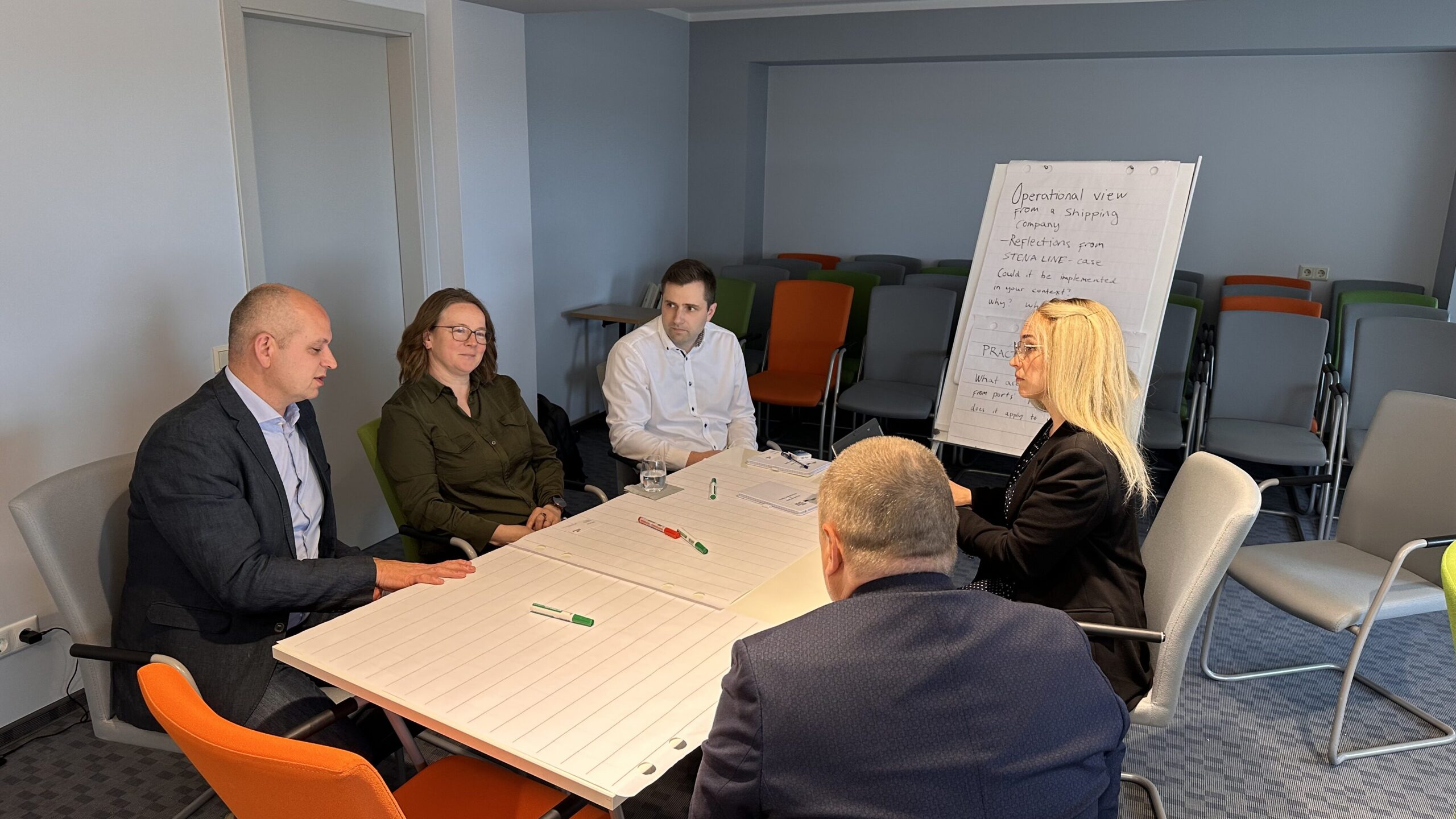
Mid-June, EUSBSR Policy Area Ship together with the Baltic Marine Environment Protection Commission HELCOM and Latvian Maritime Academy RTU organised the “First Informal Consultation Workshop on Scrubber Waste Management: Sharing Best Practices across the Baltic Sea Region“. The workshop brought together representatives from ports, authorities, industry, and research organisations to compare notes on exhaustion gas cleaning systems (EGCS), or scrubbers, and their waste management.
What are scrubbers and what is this all about?
Exhaustion gas cleaning systems, like the name suggests, are needed for cleaning the sulphur oxides (SOx) and other impurities from ship’s exhaustion gas. Unfortunately, sulphur and other impurities are still present in the waste product that scrubbers produce, and depending on the scrubber type, they often get discharged directly into the sea. With “closed loop” and hybrid scrubbers, the waste is a mix of water and sludge or solid, depending on the scrubber system itself, but it all can be collected and brought onshore for treatment in suitable facilities.
Setting the Scene under the Strategy
The workshop was opened by the PA Ship Coordinators Milla Harju and Sami Vesterinen, who explained the relevance of the topic of the workshop to the new EU Strategy for the Baltic Sea Region Action Plan and the adapted actions of PA Ship. The actions are closely connected to the HELCOM Baltic Sea Action Plan (BSAP) and their Roadmap to reduce the input of pollutants from Exhaust Gas Cleaning System discharge waters (EGCS Roadmap), which was also further elaborated by Associate Professional Secretariat of HELCOM, Marta Ruiz. The Deputy Director for Science and Innovation Ieva Demjanenko from the Latvian Maritime Academy RTU welcomed the participants to the hybrid workshop with some inspiring words.
Environmental impact
First speaker, Associate Professor & Researcher Erik Ytreberg from the Swedish Environmental Research Institute (IVL) concentrated on the effects off scrubber effluent in the marine environment. This effluent not only includes dissolved sulphur but can include many different toxins such as polycyclic aromatic hydrocarbons (PAHs) and heavy metals. Although toxins will be diluted when they enter the ecosystem, studies have shown effects at environmentally relevant concentrations on sensitive species and life stage evaluations. These studies indicate unacceptable risks in vulnerable sea areas, such as the Baltic Sea.
Shipping view
An operational viewpoint from a shipping company was offered by Fleet Superintendent Olegs Jevglevskis from Stena Line. Stena Line’s ships use hybrid scrubbers, which are a mixture of open-loop and closed-loop scrubbers where the modes can be switched. With this the closed-loop mode can be turned on in places such as Danish, Finnish and Swedish territorial waters, where it is banned to release scrubber wastewaters. In these regions the waste can be discharged onshore into port reception facilities. He also marked that once the alternative fuels take hold of the shipping sector, scrubbers and its waste would not be such a concern anymore. A presentation was given on the Best Practices from the Cruise Line Industry by Senior Director Maritime Policy Jose Gonzales and his colleague Valerie Chatterley representing Cruise Lines International Association (CLIA). They stated that the use of Exhaust Gas Cleaning System (EGCS) and discharge of washwater is highly regulated; with EGCS, cruise ships sail while meeting or exceeding water quality standards around the world, including those set by International Maritime Organization (IMO).
They also reminded how important it is for the operators to not penalize early adopters of new technologies, and to maintain a coherent regulatory framework.
Port Side
Experts from two ports brought in their knowledge and experiences; Environmental Manager Anton Airas from Port of Helsinki, and Head of International Affairs & Sustainability Edvard Molitor from Port of Gothenburg. Both ports highlighted that scrubber waste is in fact hazardous operational waste, which is not included in the no-special-fee-system set in the Baltic Sea Region. Although both ports have the capability of receiving scrubber waste, and Port of Helsinki receives it yearly approximately 300m3, however Port of Gothenburg has not received any in four years, despite regular calls of ships assumed to use scrubbers.
Tech in Place
From the technology providers side, Priit Saarlaid from Langh Ship’s Tech division gave insights on their scrubbers: they provide open-loop, closed-loop and hybrid scrubbers, and their installations can be combined with other manufacturers’ models. It is their view that the amount of wastewater from scrubbers needing discharging in ports will increase over the coming years, and it will be essential to all Baltic Sea ports to have a larger port reception facility network, with clearer and easier hand-over from vessels to shore. Mr Saarlaid also mentioned that using scrubber waste in fertilizer manufacturing or chemical industry would be a potential circular economy option in the future.
Workshop Findings
In the ever-changing world of shipping, scrubbers were introduced to reduce emissions but have imposed significant costs, requiring retrofitting and potentially further investments due to evolving regulations. Despite being seen as a transitional solution, they remain in use because of fuel cost benefits and practical constraints, while future regulations and infrastructure needs impact their actual viability.
The major challenge at stake is to ensure that the ports are willing and able to receive scrubber waste, appropriate treatment facilities are available, and clear chain of custody exists from ship to receiver and to the treatment facility. In practice, the system requires coordination between the vessel, receiving facility, treatment facility and the relevant authorities overseeing compliance.
Scrubber technologies must be evaluated within evolving maritime regulations, where compliance, environmental impact, and operational factors such as waste handling and storage play a critical role in determining their use. Their future also depends on broader challenges, including the transition to carbon-neutral shipping, limited alternative fuel infrastructure, and uncertainties around waste management capacity and costs.
Final words
In conclusion, this complicated and multifaceted topic will be relevant for at least the next 10 to 15 years to come. Regulations and restrictions on using scrubbers seem to be on the rise, but the industry should be taken into consideration in the discussions. The investments from changing from open-loop scrubbers to closed-loop scrubbers can be heavy, and maybe incentives could help in the transition. Waste management companies should be included in the discussions as well, since the amounts of waste may increase in the near future. Luckily alternative fuels will reduce the amount of toxins washing up in the seas, but what about the issues they add to the mix? That might be the topic of our next Workshop!
The day’s presentation can be downloaded here.
Related content
Nautical Mail – PA Ship Newsletter
12 October 2026