
 Back
BackGrowing interdependence reshapes energy security across the Baltic Sea
This article is originally posted on the Nordic Energy Research website on 22 September 2026.
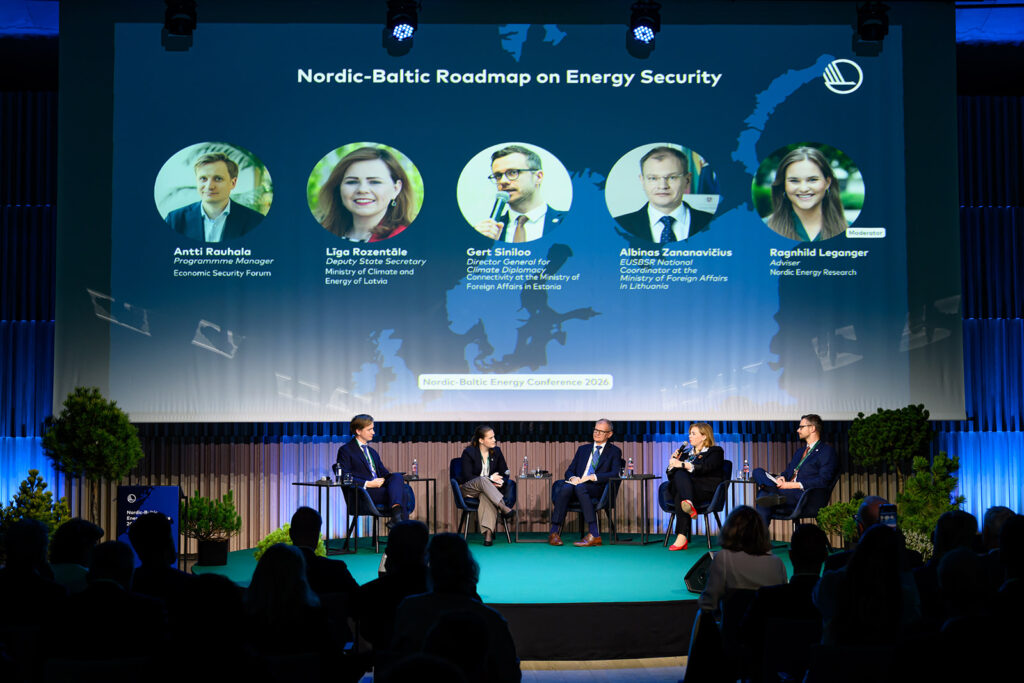
The Nordic and Baltic countries have spent decades connecting their energy systems. Now they face another challenge: how to protect them together. At the Nordic-Baltic Energy Conference 2026 in Riga, policymakers and experts pointed to concrete areas for deeper cooperation – from joint threat assessments and reserves of critical equipment to cable repair capacity and better information sharing during incidents.
“Geography matters less, interdependency matters more.”
With these words, Karen Ellemann, Secretary General of the Nordic Council of Ministers, opened the Nordic-Baltic Energy Conference 2026 and set out a central challenge for the region: as energy systems become more interconnected, security risks increasingly cross national borders too.
At the same time, rising energy demand and electrification mean that energy systems need to expand while becoming more resilient to geopolitical uncertainty, threats to critical infrastructure and the consequences of climate change.
Ellemann framed the challenge through three questions: Do we understand the risks together? Do we know how to act together when something happens? And are we building tomorrow’s energy systems for tomorrow’s threat environment?
The first high-level discussion of the conference, Nordic-Baltic Roadmap on Energy Security, explored what answering those questions could mean in practice.
Interconnection creates shared vulnerabilities
One of the key messages from the discussion was that energy security can no longer be viewed primarily through the lens of national electricity systems.
Presenting findings from the report Energy Security in the Nordics, Antti Viktor Rauhala, Chief Operating Officer at the Economic Security Forum, highlighted a contrast: Nordic electricity markets and transmission system operators are already closely connected and cooperate extensively, but there is no equally coherent regional approach to energy security.
The dependencies also extend well beyond electricity. Fuels, supply chains, critical equipment and infrastructure all affect security of supply, while electrification is creating new dependencies on critical minerals, components and equipment.
This raises a wider question for the Nordic-Baltic region: whether cooperation on protecting interconnected energy systems has kept pace with the integration of the systems themselves.
From shared risks to concrete measures
The discussion also pointed to areas where closer cooperation could become more tangible.
Recommendations in Energy Security in the Nordics include developing a Nordic-Baltic energy strategy supported by a joint annual threat assessment, establishing shared reserves of critical equipment and strengthening cooperation on access to cable repair capacity.
Some forms of practical cooperation are already under way. Līga Rozentāle, Deputy State Secretary for Energy Policy at Latvia’s Ministry of Climate and Energy, highlighted coordination among the Baltic countries on common reserves for repairs.
The next question is where broader Nordic-Baltic cooperation can add value while taking account of differences in national energy mixes, infrastructure and security priorities.
Rozentāle also stressed that preparedness needs to cover more than geopolitical and hybrid threats. Storms and other consequences of climate change can put energy infrastructure under pressure, making resilience important across a wider range of scenarios.
Closer cooperation could also bring benefits beyond preparedness, she noted, including stronger energy markets, greater opportunities for cross-border exchange and a more coordinated Nordic-Baltic voice in international forums.
Turning cooperation into operational readiness
The Nordic and Baltic countries already work together through bilateral, regional, European and NATO frameworks. Rather than creating cooperation for its own sake, participants stressed the importance of identifying where Nordic-Baltic coordination can fill practical gaps.
As Albinas Zananavičius, EUSBSR National Coordinator at Lithuania’s Ministry of Foreign Affairs, put it:
“Only bad things happen automatically in energy. For everything else, you need planning, coordination and execution.”
Gert Siniloo, Director General for Climate Diplomacy and Connectivity at Estonia’s Ministry of Foreign Affairs, similarly emphasised the need to connect political ambitions with the authorities and technical actors responsible for responding when incidents occur.
Critical undersea infrastructure was one example. Better information exchange, situational awareness and monitoring can help authorities coordinate and respond more quickly when infrastructure is damaged or disrupted.
Siniloo also pointed to the importance of learning from Ukraine’s experience of maintaining and restoring energy systems under sustained pressure.
The discussion in Riga highlighted a broader shift in Nordic-Baltic energy cooperation. As infrastructure, markets and supply chains become more interconnected, the question is no longer only how countries can benefit from those connections, but how they can prepare for and respond to the risks together.
The Nordic-Baltic Energy Conference 2026
The conference was held in Riga on 15 September by Nordic Energy Research in cooperation with the Nordic Council of Ministers offices in Estonia, Latvia and Lithuania. It brought together decision-makers, private-sector actors and other stakeholders from across the Nordic and Baltic countries to discuss energy security, security of supply and the future of regional energy cooperation.
Watch the recording of the conference here: https://lnkd.in/dnjBQ3r5