
 Back
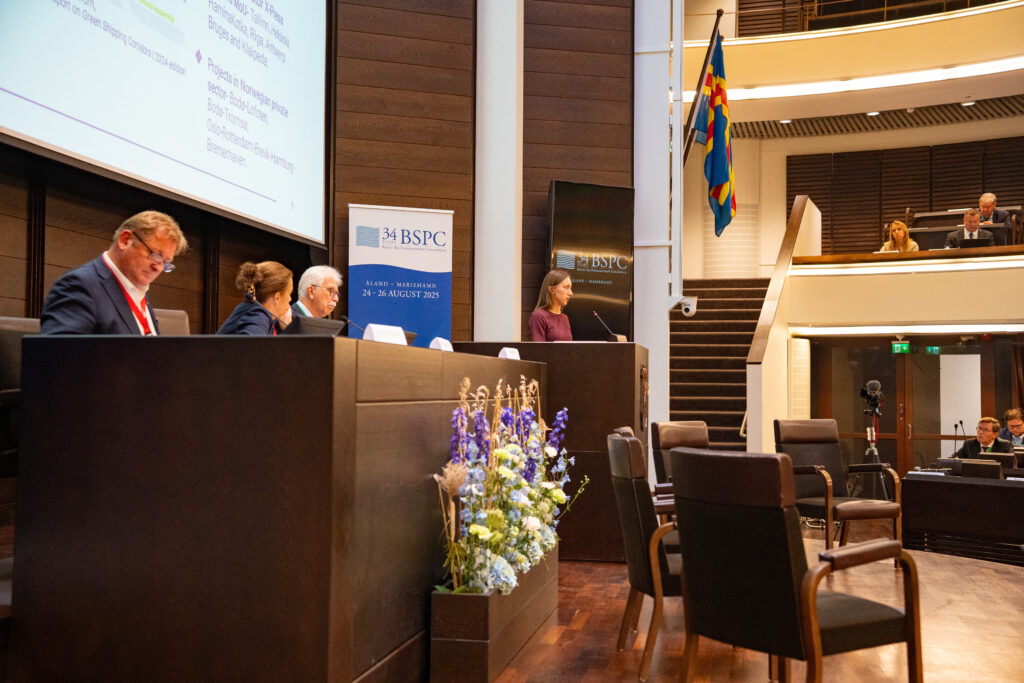
BackThe EUSBSR PA Transport participated in the 34th Baltic Sea Parliamentary Conference to highlight the potential of green shipping in the Baltic Sea region
Annabel Keerd from Policy Area Transport was invited to the 34th Baltic Sea Parliamentary Conference to share perspectives on the potential of green shipping corridors in the Baltic Sea region. While our region has notable characteristics to become a forerunner in the adoption of carbon-neutral approaches, developing resilient maritime transportation requires public-private cooperation as well as regulatory clarity.
International Cooperation in the Baltic Sea Region
The theme of the 34th BSPC was cooperation, security, and sustainability. In these circumstances, the PA Coordinator gave a presentation elaborating on green corridors as a cooperation mechanism that is vital for reaching global goals related to the reduction of greenhouse gas emissions and the enhancement of regional security.
Initiatives in Sustainabel Maritime Transportation
The development of green shipping corridors is encouraged by the European regulatory framework, including the FuelEU Maritime Regulation and strategies such as the EU Emissions Trading Scheme and the IMO GHG Strategy. For instance, notable initiatives supporting sustainable maritime transportation include the European Green Corridor Network, the European Commission’s Global Gateway Green Shipping Corridors, and the Nordic Council of Ministers and DNV’s Fuel Transition Roadmap for Nordic Shipping. Furthermore, Baltic Sea states have proactively integrated green corridors into their national strategies. At the private level, numerous Memoranda of Understanding have been signed between ports and private companies.
Regional Potential and Challengies
The regional potential for implementing the concept of green corridors lies in the unique strengths of the region: short distances, heavy traffic, a high proportion of ferry lines, a dense population, and even a vibrant leisure boating culture. As transportation hubs, ports are strategic assets supporting our supply chains and security. Simultaneously, ports in the Baltic Sea are becoming laboratories for green technologies and intelligent systems, attracting investments and state participation. However, the Baltic Sea states face a lack of policy instruments and business models. The absence of specific criteria defining a green shipping corridor hinders cooperation between countries and ports, in turn complicating the development of technologies and the attraction of investments. There is a need for coordinated legal frameworks and transparent regulatory oversight for green shipping initiatives, also to prevent potential greenwashing attempts where activities are misleadingly labeled as green shipping corridors.
Building green shipping corridors can be seen as a conceptual approach that encompasses the entire value chain and reduces reliance on road transport. Simultaneously, green shipping corridors encourage modal shift, contributing to the mitigation of greenhouse gas emissions.