
 Back
Three EU macro-regional strategies compare approaches to policy impact
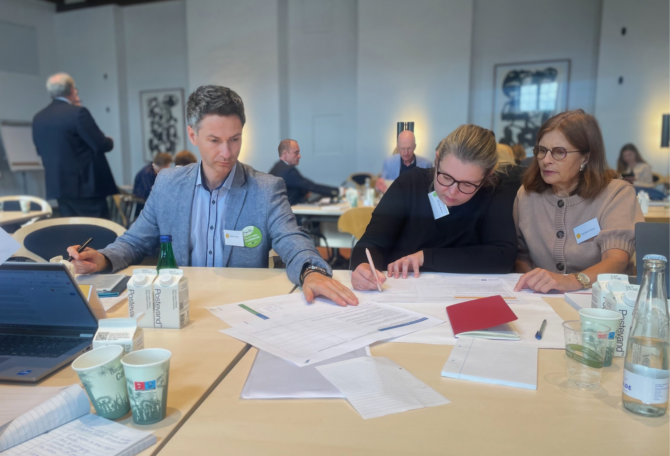
How can cooperation between countries lead to policy change, and how can that contribution be demonstrated? Coordinators from the EU strategies for the Baltic Sea, Danube and Alpine regions met in Stockholm on 12 November 2026. They compared how they implement action plans, engage stakeholders and assess results.
Anders Bergström and Asli Tepecik Dis of Föreningen Norden (Norden Association Sweden) hosted the meeting. Both serve as Policy Area Coordinators for Policy Area Education under the EU Strategy for the Baltic Sea Region (EUSBSR). The exchange focused on how macro-regional strategies contribute beyond individual projects. They bring together public authorities, practitioners and other partners to exchange knowledge and develop joint approaches. This helps connect their work to shared policy priorities.
Different approaches, a shared purpose
The three strategies illustrated different ways of organising and sustaining cooperation.
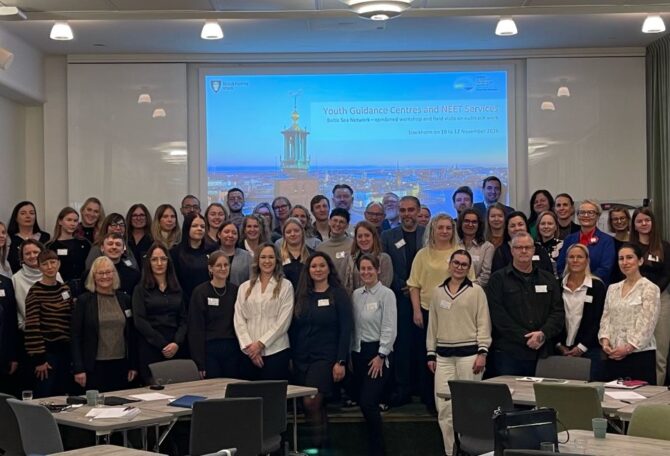
EUSBSR Policy Area Education presented its approach to long-term collaborative platforms, known as flagships. The School to Work flagship and its Baltic Sea Network for Youth Guidance Centres and NEET Services provided a concrete example. Earlier that week, the network brought practitioners together in Stockholm to explore ways of reaching young people not in education, employment or training (NEET). The discussions included young people who do not actively seek support.
The exchange illustrated how cooperation can develop beyond individual projects by connecting practitioners, sharing methods and identifying opportunities for continued joint work.
Representatives of the EU Strategy for the Danube Region (EUSDR) presented the work of Priority Area 9, People and Skills. Its approach combines a rolling work programme, regular steering group meetings, thematic workshops and stakeholder conferences. Examples included work on Roma inclusion in the labour market and exchanges supporting countries preparing for EU accession.
The EU Strategy for the Alpine Region (EUSALP) shared experiences from Action Group 3, focusing on labour market, education and training. Its activities include jointly developing work plans and holding facilitated planning sessions. For example, the Discover Mountain Jobs initiative introduces young people to employment opportunities in Alpine communities.
Despite differences in their implementation approaches, the three strategies share an important objective: bringing together stakeholders across borders to address challenges that cannot be effectively tackled by individual organisations or countries alone.
Measuring what cooperation makes possible
A central question throughout the discussions was how to assess the results of these different approaches.
Project outputs, such as events, publications and completed activities, are relatively straightforward to record. Changes in working methods, stronger partnerships, improved coordination and the uptake of ideas across borders are more difficult to capture.
Policy Area Education shared its approach to monitoring policy impact, including policy briefs, policy dialogues, policy developments, alignment of funding and stakeholder engagement. The discussion also highlighted the importance of understanding whether knowledge gained through international exchanges influences practice after participants return to their organisations.
The exchange reinforced the need to look beyond immediate outputs and consider how cooperation contributes to longer-term policy development and institutional learning.
Communicating the value of macro-regional cooperation
Participants also reflected on how to explain the role and added value of macro-regional strategies more clearly.
Unlike individual projects, macro-regional strategies do not necessarily implement activities directly. Their contribution often lies in connecting relevant stakeholders, facilitating dialogue, supporting cooperation across sectors and countries, and creating conditions for shared learning to inform policy and practice.
This presents a communication challenge. While project results are often visible and measurable, the processes that enable cooperation and policy development can be less tangible.
Participants discussed the importance of strategic communication that explains not only what activities take place, but also why they matter and what they make possible.
Future funding and opportunities for continued exchange
Looking ahead, participants discussed the proposed National and Regional Partnership Plans (NRPPs) under the EU’s future long-term budget.
The exchange provided an opportunity to compare perspectives on how transnational cooperation and macro-regional priorities could be better recognised within future funding arrangements. Participants also reflected on the importance of connecting macro-regional strategies with funding programmes that can support the implementation of shared priorities.
Possible future exchanges with European Commission services in Brussels and further participation in one another’s thematic activities were also discussed.
The Stockholm meeting highlighted the value of continued cooperation between the Baltic Sea, Danube and Alpine strategies. By comparing implementation approaches, sharing practical experiences and examining how to demonstrate policy impact, the three strategies can continue learning from one another and exploring opportunities to address shared challenges.