

 Back
BackTowards cleaner waters with EU cohesion funding
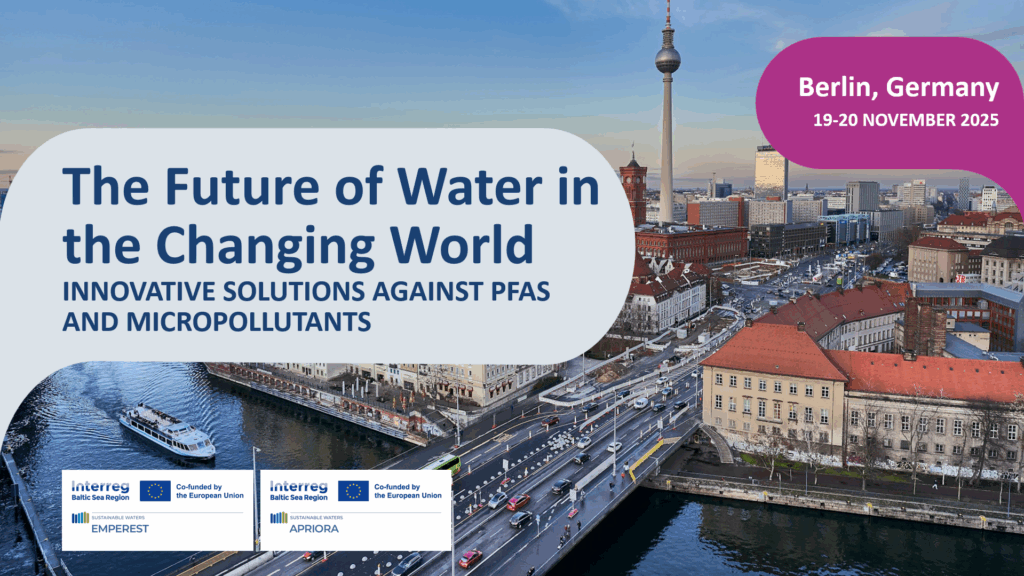
On 19 and 20 November 2025, 170 water experts from different countries will gather at Berlin Kulturbrauerei to discuss solutions to the problem of hazardous chemicals in the Baltic Sea. The conference is organized by two projects, EMPEREST and APRIORA, co-funded by the EU Interreg Baltic Sea Region Programme 2021–2027. Both projects stem from EU legislation change, namely the revision of the directive regulating urban wastewater treatment. The revised directive sets new requirements especially concerning the removal of micropollutants from wastewater. To support the implementation of the directive in the Baltic Sea Region, EMPEREST (€4.35 million Interreg BSR funding) and APRIORA (€1.92 million) projects are delivering solutions and validated results to operators, authorities and decision-makers in the Baltic Sea Region. These solutions and results will support the wave of investments needed in the near future.
The revised directive aims to better protect human health and the environment from the effects of untreated urban wastewater. Large wastewater treatment plants with a pollution load of over 150,000 people will be required to introduce quaternary treatment to remove a broad spectrum of micropollutants by 2045. EMPEREST project supports these investments with its pilots on micropollutant removal technologies. Medium-sized plants will need to adopt quaternary treatment if risk assessment indicates a significant impact on downstream water use or ambient water quality, to which APRIORA project offers solutions. Overall, to meet the requirements of the new directive, the European Commission estimates total investment costs of €28.6 billion by 2040, of which €9 billion is related to micropollutant treatment.
Turning new EU legislation into reality through two projects
The APRIORA project is developing a risk assessment framework that integrates and combines monitoring, modelling and multi-criteria risk evaluation. Further, APRIORA experts have created an open-source GIS tool for visualizing pollution data and providing regional risk maps that clearly indicate which WWTPs need action first. The tool can be tested during a workshop session at the conference.
The experts in the EMPEREST project built mobile pilot plants with which quaternary treatment technologies were tested in seven cities across the Baltic Sea Region: Gdańsk, Szczecin, Kaunas, Tartu, Tallinn, Turku and Riga. The pilot plants demonstrated the effectiveness of advanced treatment technologies such as ozonation, granular activated carbon, ion exchange, and nanofiltration for removing organic micropollutants listed in the revised directive, reaching the removal efficiency between 89 and 100% on the pilot scale. To some extent, the technologies were also able to remove PFAS compounds. The EMPEREST partnership has succeeded in past projects for example in including inputs to the HELCOM Regional Nutrient Recycling Strategy, delivering new solutions for nutrient removal and sludge management, creating innovative tools to advance energy efficiency in wastewater treatment, and contribution to the revision of HELCOM Recommendation 23/5 on the reduction of discharges from urban areas through proper management of stormwater system. However, removing micropollutants and especially PFAS from wastewater is not enough. Decreasing the release of hazardous substances into the environment in the first place is equally important. To strengthen this work, the EMPEREST project also worked at source, supporting local authorities with PFAS risk-assessment tool for local authorities for identifying their possible PFAS pollution hotspots – such as landfills, airports, and firefighting training sites – and mitigating the risks. Furthermore, the EMPEREST project published guidelines for monitoring and assessment of PFAS in the water bodies of the Baltic Sea Region. Finally, EMPEREST trainings have addressed gaps in knowledge regarding hazardous substances among different target audiences, such as local authorities and water service operators.
EMPEREST project grande finale
The conference in Berlin will be a high-impact event where thought-leaders and innovators from eight Baltic Sea Region countries come together for presentations, panels, interviews, and hands-on study visits exploring the challenge of micropollutants and the cutting-edge project results shaping the future of clean water. The participants are professionals, spanning water utilities, government, environmental NGOs, industry, and research. The conference in Berlin will consist of presentations, panels, interviews and study visits related to micropollutant pollution in water, solutions to the problem, and the results of the two projects. The speakers include Mr. Michel Sponar, Deputy Head of Unit at the European Commission, Directorate General for the Environment, Professor Adolf Eisenträger, the Head of German Center for Micropollutants at the German Environment Agency, Ms. Lotta Ruokanen, Deputy Executive Secretary of the Baltic Marine Environment Protection Commission (HELCOM), and Dr. Henna Rinne, Senior Specialist at the Ministry of the Environment in Finland. Conference participants can also choose from several excursion options, including a visit to the remediation facility in Berlin Tegel where PFAS compounds are removed from groundwater. The conference marks the end of the EMPEREST project, while APRIORA still continues its work for another year. The 14 partner organisations of EMPEREST have a long history of transnational collaboration, and an impressive record of results addressing both the practical application of solutions and contributions to regional water policy development. The current project is the first one in which this partnership has worked specifically on micropollutants.
More information
Lotta Lehti
Project Coordinator / Lead Partner of EMPEREST project
Union of the Baltic Cities, Sustainable Cities Commission
c/o City of Turku
lotta.lehti@turku.fi
+358 449 073 527
Vanha Suurtori 7, 20500 Turku, Finland
Vanessa Ingold
Project Coordinator / Partner of EMPEREST project / Local host of the conference
DWA-Landesverband Nord-Ost
dwa@dwa-no.de
+4915770279749
Halberstädter Straße 40a, 39112 Magdeburg, Germany
Prof. Dr. Jens Tränckner
Project Coordinator / Lead Partner of APRIORA project
jens.traenckner@uni-rostock.de
+49 381 498 3640
Rostock University
Faculty for Agriculture, Civil and Environmental Engineering
Water Management
Satower Str. 48, D- 18059 Rostock, Germany
Alena Seidenfaden
Project Coordinator / Lead Partner of APRIORA project
alena.seidenfaden@uni-rostock.de
+49 381 498 3471
Rostock University
Faculty for Agriculture, Civil and Environmental Engineering
Water Management
Satower Str. 48, D- 18059 Rostock, Germany
- Conference website: https://interreg-baltic.eu/event/final-conference-the-future-of-water-in-the-changing-world/
- EMPEREST Project website: https://interreg-baltic.eu/project/emperest/
- APRIORA Project website: https://interreg-baltic.eu/project/apriora/
- Directive (EU) 2024/3019 of the European Parliament and of the Council of 27 November 2024 concerning urban wastewater treatment (recast): https://eur-lex.europa.eu/eli/dir/2024/3019/oj/eng
Related content
New funding opportunities at Swedish Institute
26 February 2026
Save the Date: BSSSC Day of Cities and Regions 2026 in Tallinn
28 January 2026