
 Back
BackSaving the sea, one ship at a time: a call for sustainable maritime action in the Baltic Sea
The Baltic Sea is the world’s second largest brackish water ecosystem, semi-enclosed and shallow. Due to the narrow straits between Denmark and Sweden the exchange of water with the North Sea is limited and slow, resulting in long residence time of water (including pollutants) as well as low and varying levels of salinity. At the same time, the area hosts a unique mix of marine, brackish-water and freshwater life forms. The Baltic marine ecosystem is therefore considered as particularly sensitive and vulnerable to disturbances by human activities, including shipping. More than 2,000 ships are en route in the Baltic Sea area at any given moment, not including ferries, smaller fishing vessels or leisure craft. Hence, the Baltic Sea has some of the densest maritime traffic in the world which is even increasing. Also, the nature of traffic has changed. More oil and harmful substances are being transported.
But also new alternative fuels emerge (e.g. ammonia) and carry new associated risks for the marine environment that still need to be fully understood.
In recognition of its particularly vulnerability, the Baltic Sea has already been designated as a special area for the purposes of MARPOL Annex I (oil), Annex IV (sewage), Annex V (garbage) and Annex VI (air pollution), as well as a Particular Sensitive Sea Area (PSSA).
However, the Baltic Sea is still under threat. Despite stricter special area regulations, ships continue to discharge harmful substances, particles, and nutrients (e.g., scrubber discharge water, sewage, grey water, cargo residues, plastic), contribute to air pollution and global greenhouse gas emissions (CO2, SOx, NOx, particulate matter, black carbon), introduce invasive species (e.g., by biofouling), as well as cause underwater noise that can be harmful to marine biota.
In addition, the so called ‘shadow fleet’, consisting of an increasing number of old and poorly maintained vessels that operate without Western insurance and with only minimal regard to regulations, poses a significant environmental, maritime safety, and security risk.
While IMO sets the global regulatory framework, regional co-operation (e.g. HELCOM) is key for teaming up and taking regional-harmonized measures, developing new regulations and supporting effective implementation and enforcement of existing IMO regulations in the region. Research and pilot projects can play a pivotal role in identifying the best environmental practices and best available technologies. Also, shipping impacts marine life obviously in more than one way. Mitigation measures should therefore take a holistic approach, assess the impact of measures with regard to other relevant pressures. Biofouling management, for example, prevents the introduction of invasive species, but also contributes to energy efficiency and the reduction of GHG. Certain propeller designs, on the other hand, may improve the energy efficiency of a vessel, but cause more underwater noise.
Finally, to fight climate change, the 2023 IMO GHG Strategy and its short and mid-term measures are high on the political agenda. So-called Green Shipping Corridors are es-tablished to drive the initial decarbonization of the maritime industry linking ports that support zero-emission fuels.
Policy Area Ship Coordinator’s Comment
Aligning itself with the three overall objectives of the EUSBSR Strategy, the Policy Area Ship supports this work to develop sustainable shipping in the region in very concrete terms. First of all, Policy Area Ships actions are contributing to Save the Sea by supporting specific research and projects on shipping related issues to reduce emissions, develop new environmental technologies and improved shore-side facilities. In this context, the Policy Area Ship also supports HELCOM’s work, specifically the implementation of the Baltic Sea Action Plan (BSAP) and its shipping related actions. Encouraging region wide coopera-tion and projects, Policy Area Ship Connects the Region. Finally, achieving a good environmen-tal status and maintaining the Baltic Sea healthy will Increase prosperity in the region – not only for the people in the region, but for all the habitants of the sea from algae to porpoises. We all will benefit from the Baltic Sea’s ecosystem services and its unique beauty and intrinsic values.
Policy Area Ship Coordinators
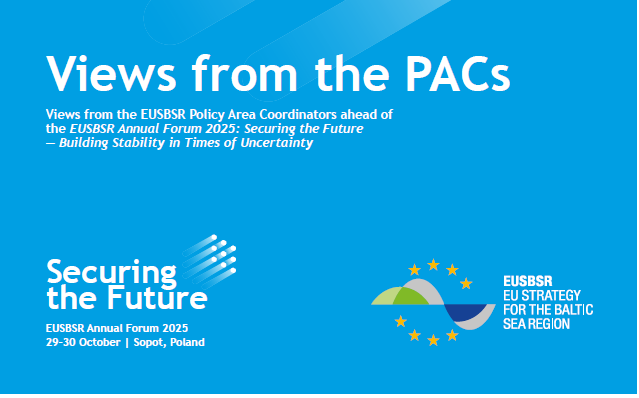
Securing the Future – Views from the Policy Area Coordinators
This text is originally published in the “Securing the Future – Views from the Policy Area Coordinators” publication. The publication consists of thematically focused articles that are aligned with the Strategy objectives. The texts support informed discussion on topics relevant across the Baltic Sea Region.
Download the full publication here.