
 Back
BackPolicy Area Health gathers Nordic-Baltic and Ukraine public health experts to identify best practices for social innovation transfer
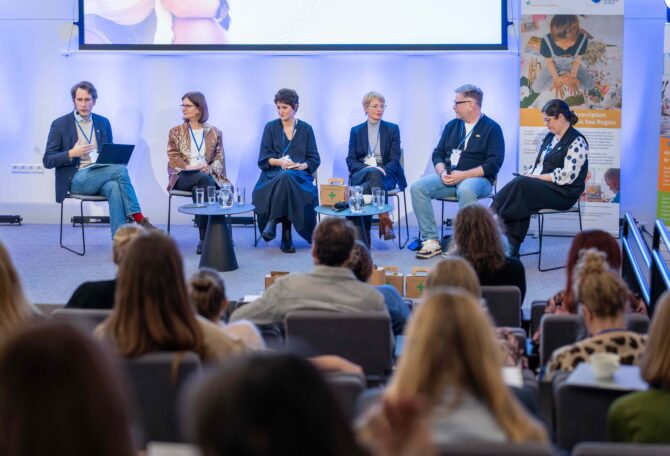
Public health experts from Germany, Estonia, Finland, Latvia, Lithuania, Norway, Sweden and Ukraine recently came together for a workshop focused on exploring framework conditions for social innovation transfer. Organized by the Policy Area Health coordinator, Secretariat of the Northern Dimension Partnership in Public Health and Social Well-being (NDPHS) in Stockholm, the “Transferability Workshop” aimed to identify successful public health interventions in the Baltic Sea region that could be adapted and implemented in other countries facing similar challenges.
An innovation does not always have to be completely new, it can also be new to a given context,
Hauke Siemen, REM Consult, Germany.
Just like Baltic Sea region countries share similar success stories and innovations in public health, they also grapple with issues like decreasing mental well-being, limited health care resources, and ageing population. Though countries have developed various approaches to address these public health concerns, social innovation transfer allows for sharing knowledge about interventions that work, learning from each other, and gaining insights into why some interventions succeed while others struggle. In short, social innovations refer to the development and implementation of new products, services and models to meet social needs and create new social relationships and collaborations with an aim of improving human well-being.
The Policy Area Health workshop brought together over 40 participants from national ministries of health, research institutions, universities, small enterprises, and non-governmental organizations under three PA Health ongoing projects “Economy of Well-being of People”, “MentalHealthMatters” and “Solutions for Age-Friendly Employers”. Discussions focused on specific public health practices around mental health at work and age-friendly workplaces. A key outcome was recognizing that successful interventions and innovation transfer depend heavily on various factors:
- Understanding the context of both the place of origin and place of adoption,
- Organisational setup,
- Communication and framing (why are you doing it and why it works),
- Economics (social business model, costs and benefits)
- Long term perspective.
Innovations have to be translated and customized to improve the ‘fit’ with local conditions. The workshop invited participants to share their knowledge about putting innovation transfer to practice that will help countries work smarter, not harder.
The workshop was the final event for the Swedish Institute –funded project Economy of Well-being of People, showcasing the methodology prepared during the project. Read more HERE.
Related content

New funding opportunities at Swedish Institute
26 February 2026
Save the Date: BSSSC Day of Cities and Regions 2026 in Tallinn
28 January 2026