
Get involved in Policy Area Bioeconomy activities!
Policy Area Bioeconomy serves as a body where local, regional, macro regional and international organisations (private and public) become involved, to horizontally improve and widen the impact of different strategic frameworks. Moreover, it is planned to invite youth participants and participation from Norway. Representatives within the actions, from projects and activities etc., are another important stakeholder group. Policy Area Bioeconomy aims to provide a structure that can facilitate development of activities, which can feed into the strategic frameworks and are supported by the Action plan – specifically connected to our three actions of priority.
Past activities
Unlocking the Potential of Industrial Symbiosis: A Pathway to a Bioeconomy in the Baltic Sea Region
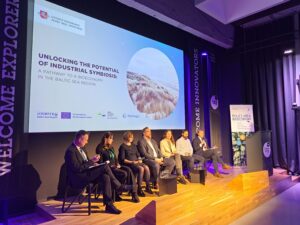
On December 3, 2024, the Lithuanian Ministry of Agriculture hosted a seminar titled “Unlocking the Potential of Industrial Symbiosis: A Pathway to a
Bioeconomy in the Baltic Sea Region.” The event aimed to clarify the relationship between overarching goals—such as sustainability, the green economy, and the circular economy—and practical approaches, including valorization and industrial symbiosis.
The seminar began by defining key concepts, followed by presentations demonstrating how industrial symbiosis can serve as a powerful model to drive the transition to a green and bio-based economy. These presentations highlighted practical steps for fostering collaboration between industries, creating value along supply chains, and addressing potential challenges.
Participants also benefited from insights shared by businesses and public sector actors in the Baltic Sea Region, showcasing real-world examples of industrial symbiosis in action.
A central element of the Seminar was the presentation of the results of the report Industrial Symbiosis – an end or a means? (industrial-symbiosis-bsr-nordregio)
The Seminar was arranged as a hybrid event and a recording can be accessed on this link.
Agenda for the Seminar:
Moderator: Marius Jokūbaitis
Opening – Laura Ramanauskaitė, Vice minister of Agriculture of the Republic of Lithuania (5 min)
What is (bio) industrial symbiosis and how can it contribute to circular economy? – breaking down concepts – Alberto Giacometti, Senior Research Advisor, Nordregio, Sweden
Research perspective: Status quo of industrial symbiosis in the Baltic Sea Region, key lessons, enablers and challenges – Alberto Giacometti, Maija Kāle, Anna Berlina, Nordregio, Sweden
Shaping Lithuania’s secondary raw materials system: the role of industrial symbiosis – Teresė Škutaitė, Head of GreenTech Hub, Innovation Agency Lithuania
Industrial symbiosis: practical case and experience. Sotenäs Symbiosis Centre, Sweden – Stina Gottlieb, Sweden (online)
Stimulating innovative solutions for industrial symbiosis in the BSR – Bioboosters experience – Lina Stanionytė, International project coordinator of Sunrise Tech Park, Lithuania
Industrial symbiosis: practical case and experience: JSC “Balticovo” – Toms Auškāps, Director of Communications and Development, Board Member (online)
Industrial symbiosis: practical case and experience – Kemi-Tornio – Janne Rautio, Project Manager, Digipolis Technology Park and Circular Economy Centre in Kemi, Finland
Industrial symbiosis: practical case and experience – “Sinergia” – Platform for industrial symbiosis – Vanda Rogovska and Laura Kristiāna Vičmane, Project Managers at “Sinergia”, Latvia
Panel discussion on development of bio-industrial symbioses (50 min.)
Participants: Torfi Johannesson, Consultant of Nordic Council of Ministers, PA Bioeconomy under EUSBSR, Alberto Giacometti, Senior Research Advisor, Nordregio, Teresė Škutaitė, Head of GreenTech Hub, Innovation Agency Lithuania, Lina Stanionytė, International project coordinator of Sunrise Tech Park, Janne Rautio, Project Manager, Digipolis Technology Park and Circular Economy Centre in Kemi, Vanda Rogovska, Project Manager at “Sinergia”.
Wrap-up – summarizing learnings ‒ Dalia Miniataitė, Chief advisor to the Ministry of Agriculture of the Republic of Lithuania and participants of Panel discussion
From Sustainable Agriculture to Healthy and Sustainable Food Choices
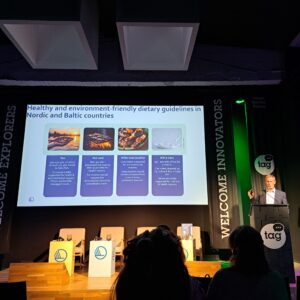 On September 24, 2024, the Ministry of Agriculture in Lithuania hosted the conference From Sustainable Agriculture to Healthy and Sustainable Food Choices. The event aimed to raise awareness among stakeholders about the Nordic Nutrition Recommendations, foster public dialogue—particularly among key target groups—on sustainability and healthier diets, and inspire producers to adopt more sustainable food production methods while expanding the availability of healthy options. Additionally, the conference served as a platform to share best practices, experiences, and insights from projects carried out in the Baltic Sea Region.
A full recording from the conference is available HERE.
PA-Bioeconomy at Macro-regional & Sea Basin Strategies Days 2024
On 12 and 13 June 2024, the four Macroregional and three Sea Bassin strategies (Alpine, Danube, Adriatic-Ionian, Baltic Sea, Atlantic, Western Mediterranean and Black Sea) met in Brussels for a joint event. PA-Bioeconomy was invited to participate in a panel at one of the first day sessions: Energy transition, climate change, and risk management. Our main message was that solving the complex problems facing the blue economy in the Baltic Sea requires the involvement of multiple actors, in many different sectors in many countries and regions. Exactly what Macro regional strategies are best at!
WEBINAR: Food security around the world with regional, local and individual relevance
On May 31 2024 PA-Bioeconomy, together with PA-Secure and the Nordic Council of Ministers’ office in Latvia organised a workshop on food security and civil preparedness. We had a unik mix of experts from different countries and fields to share their insights on food security and ways to enhance it.
The red line through the workshop was that food security must be tackled on various levels: global/international, national/regional, and individual. This multi-level approach is essential to ensure a robust and resilient food system. By addressing food security on multiple levels—from personal preparedness to regional and global cooperation—the workshop provided comprehensive insights into creating resilient food systems for the future.
Dr. Bettina Rudloff set the stage by explaining new developments in challenges and policy responses to food security risks. These risks have been exacerbated by the changing geopolitical landscape. Understanding these global challenges is crucial for developing comprehensive strategies that can mitigate risks and enhance food security on a global scale.
Following Dr. Rudloff’s presentation, the workshop transitioned to discussing strategies for securing food supplies both in the short and long term. This discussion highlighted the importance of preparedness at all levels of society, from individuals to nations.
The first line of defense against food insecurity is personal preparedness. Preparedness Specialist Essi Kulju discussed national recommendations in Finland, emphasising that most Nordic and Baltic countries urge their citizens to stock up for at least 72 hours, with some suggesting a week’s worth of supplies. These recommendations are crucial for ensuring that individuals can cope during initial disruptions e.g., 72 hours – Could You Cope on Your Own?, Sikker hverdag and Hemberedskab – preppa for en vecka.
Looking ahead, the resilience of cities and the shortening of supply lines were key topics. Maija Kāle, PhD presented a new project on Urban Agriculture. This project ranges from window-sill herbs to community gardens and industrial hydroponics complexes. Urban agriculture can serve as a valuable buffer for food supplies in cities, reducing dependence on long supply chains and enhancing local food security.
At the regional and national levels, the responsibility to develop infrastructure, secure linkages to other regions, and foster local food production is paramount. Alda Nikodemusa emphasised that national security is built from the regional situation. Research Project Coordinator Lena Maria Nilsson also gave a fascinating presentation on food security in Sami populations, showcasing how Traditional Intelligence (TI) often outweighs Artificial Intelligence (AI) in these communities.
Special Advisor Arne Bardalen presented data from a recent Norwegian report – Norsk matsikkerhet i en ustabil verden – demonstrating the importance of looking across food categories and time periods to understand food security comprehensively. Norway has a caloric self-sufficiency rate of 46%, which drops to 40 % when accounting for imported animal feed (2023). This illustrates the challenges countries face in achieving high and stable self-sufficiency..
However, a strategic blend of existing production capabilities, stockpiling, and supportive neighbours can significantly bolster a country’s resilience during a crisis.
Introductory Webinar on EUSBSR and the Roles of Steering Groups
On December 11, 2023, PA-Bioeconomy organized an introductory webinar for its Steering Group members, aimed at providing general information on the EU Strategy for the Baltic Sea Region (EUSBSR) and, more specifically, outlining the role of Steering Groups within this framework. We were honored to welcome Anders Bergström, a former HA-Capacity resource and policy area coordinator for PA-Education, as the main speaker for the session.
The webinar garnered positive feedback from participants and is anticipated to lay the foundation for a more streamlined and effective working approach within PA-Bioeconomy.
Extreme weather events and their impact on nutrient leakage from rural areas
On December 4, 2023, PA Nutri and PA Bioeconomy, in collaboration with the Coalition Clean Baltic, organized a workshop addressing “Extreme Weather Events and Their Impact on Nutrient Leakage from Rural Areas.”
This workshop targeted a select group of stakeholders representing authorities, farmer associations, advisors, and NGOs from across the Baltic Sea Region. Its primary objective was to facilitate discussions on various aspects of water management, including perspectives from farmers, mitigation measures, and river management strategies. Additionally, the workshop aimed to identify priority topics and themes for subsequent events.
The overarching goal of this series of events is to initiate a dialogue process centered on sharing best practices in innovative water management measures and stakeholder engagement. It also seeks to catalyze progress towards integrated water management, aligning with the implementation of the 2021 Baltic Sea Action Plan (BSAP) Action E19. This action advocates for the application of innovative water management measures, such as lime filter ditches, sediment traps, controlled drainage, and nature-based solutions like two-level ditches and constructed wetlands, particularly in the context of upgrading and renovating agricultural drainage systems.
Feedback from the workshop’s 20-30 participants was overwhelmingly positive, and plans are underway to organize follow-up events in 2024 to further advance these important discussions and initiatives.
Strengthening and developing cooperation with Ukraine to empower sustainable rebuilding
On the 14th Annual Forum for the EUSBSR, Policy Areas Nutri, Hazards, Ship and Bioeconomy joined forces with the CBSS and the Swedish Institute to discuss how to help Ukraine on their road towards a full EU-partnership and sustainable rebuilding.
The workshop aimed at exploring needs for future cooperation between the Baltic Sea region and Ukraine, focusing on how to empower sustainable rebuilding. The workshop was opened by Johan Magnusson from EU DG REGIO with messages from the EU about how the support for Ukraine will continue and deepen in the future. This important message was followed by a discussion between Nadija Afanasieva (Ukrainian Institute of International Politics), Camilla Wristel (Swedish Institute) and Lotta Ruokanen(HELCOM) moderated by Torfi Johannesson.
The panel discussion was followed by roundtable discussions. There were four different roundtables, each hosted by Policy Area coordinators (Nutri, Hazards, Ship, Bioeconomy) and joined by a Ukrainian expert, an expert from the Baltic Sea Region and a youth participant. The audience joined in the roundtable discussions. Main results of the discussions were collected by the youth participants and coordinators.
Some key results:
- Needed communities for cooperation: self-governments, communities, universities, youth
- Fields for cooperation: knowledge sharing, education, practical lessons learnt in the Baltic Sea Region
- The cooperation must address the current and future challenges in Ukraine and exact data on issues and then offer tailored support to the identified needs. In some cases, exchange and support on how to monitor and obtain data can be part of the collaboration
- Networks of cities can act as first aid in getting the know-how to Ukraine: EURO-CITIES and twin cities are an already existing network and can help in finding needs and setting up monitoring systems
- Fostering an open dialogue between Ukraine and the Baltic Sea region to exchange innovations and lessons learned. It is also useful to acknowledge that there are currently many EU and regional funding instruments with possibilities for supporting Ukraine.
A blog post about the workshop, written by Elsi Kauppinen, Policy Area Nutri Coordinator is available on the EUSBSR homepage.