

 Back
BackPolicy Area Spatial Planning Contributes to Discussion on Future EU Strategy for Coastal Communities
European Ocean Days 2026, Brussels, 6 March 2026.
During European Ocean Days 2026 in Brussels, VASAB contributed to the panel discussion “Towards an EU Strategy for Coastal Communities”, organised by the European Commission’s Directorate-General for Maritime Affairs and Fisheries (DG MARE). The session formed part of the consultation process for the forthcoming EU Strategy for Coastal Communities, which aims to strengthen the resilience, sustainability and economic potential of coastal territories across Europe.
The discussion brought together representatives from EU institutions, macro-regional initiatives and national authorities to exchange views on the main challenges facing coastal communities and to identify priorities for future EU policy support.
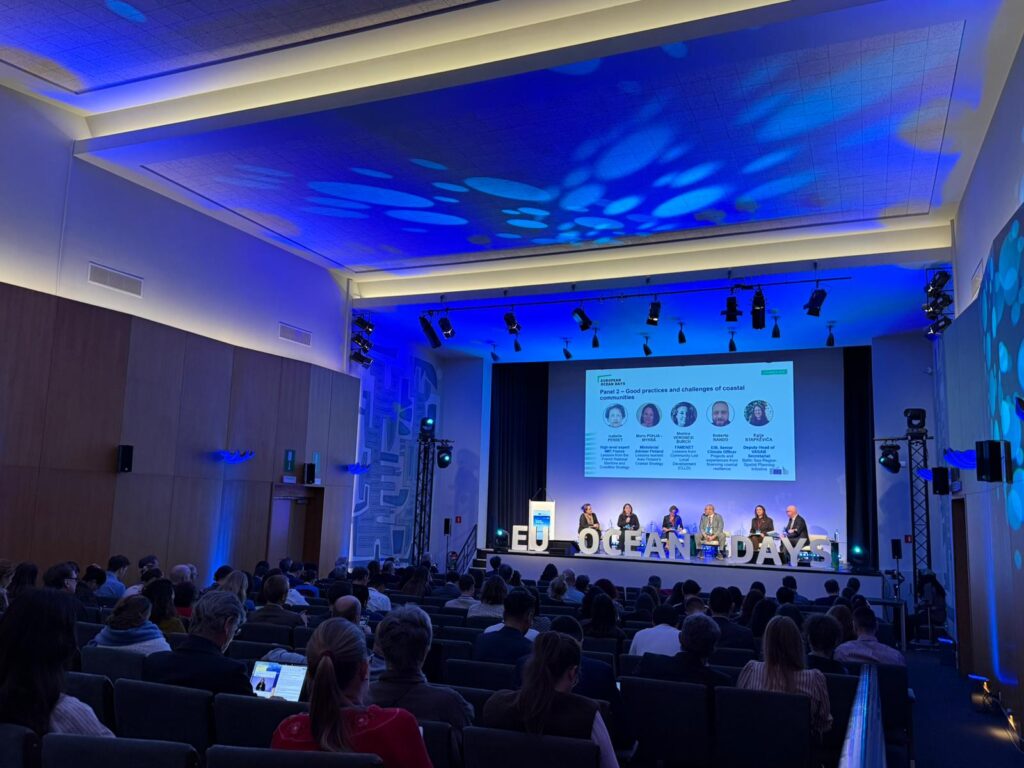
Strengthening Coastal Communities in Europe
Coastal regions play a key role in Europe’s sustainable blue economy while also facing multiple and interconnected challenges. Panellists highlighted growing pressures from climate change, increasing competition for maritime space, and socio-economic transitions affecting traditional sectors such as fisheries and coastal tourism.
Participants emphasised that the future EU strategy should help coastal communities remain attractive places to live and work while supporting sustainable economic opportunities and environmental protection.
Baltic Sea Region Perspective
Representing the Baltic Sea Region, VASAB shared experience from macro-regional cooperation on spatial planning and specifically maritime spatial planning.
In the Baltic Sea Region, cooperation between governments, spatial planners and regional organisations has helped strengthen coordination across national borders and improve the integration of land and sea planning. VASAB works closely with its strategic partner HELCOM and spatial planners across the region to promote integrated spatial planning approaches and support dialogue between governance levels.
The Baltic Sea experience demonstrates that spatial planning can play an important role in managing competing uses of marine space while supporting long-term territorial development and resilience of coastal communities. This experience is also informed by the results of several cross-border cooperation projects relevant to Policy Area Spatial Planning under the EU Strategy for the Baltic Sea Region.
National Perspective: Finland’s Coastal Strategy
The panel also featured the Finnish national perspective, highlighting the development and implementation of Finland’s Coastal Strategy. The Finnish approach emphasizes integrated coastal management and strong cooperation between national authorities and local municipalities.
This example illustrated how national strategies can support sustainable coastal development while ensuring that local conditions and community needs are taken into account.
Key Messages for the EU Strategy for Coastal Communities
Several key messages emerged from the discussion that may help inform the future EU strategy:
- Strengthening spatial planning capacity and the capacity of planners at all governance levels is essential for sustainable coastal development.
- Improved coordination between land and sea planning is needed to address increasing pressures on coastal and marine areas.
- Multi-level governance and stakeholder engagement should be further strengthened to ensure that coastal communities are actively involved in planning processes.
- Cross-border cooperation, particularly in shared sea basins, can help address common environmental and development challenges.
- Regional specificities should be taken into account when implementing EU policies for coastal areas.
Contribution to the European Policy Debate
The panel discussion provided an opportunity for VASAB to bring the Baltic Sea Region perspective into the broader European discussion on coastal governance. The experience of macro-regional cooperation highlights the importance of integrated spatial planning and coordinated governance approaches in supporting resilient and sustainable coastal communities.
VASAB looks forward to continuing its contribution to the development of the EU Strategy for Coastal Communities, sharing lessons learned from the Baltic Sea Region and strengthening cooperation between spatial planners across Europe.
Related content


Open call for VASAB Young Planners’ Summer School 2026
10 March 2026