

 Back
BackAnnual Forum 2025 – New Circular Economy Solutions: Perspectives to Circular Economy in a Panel Discussion
Circular Economy Across the Sectors
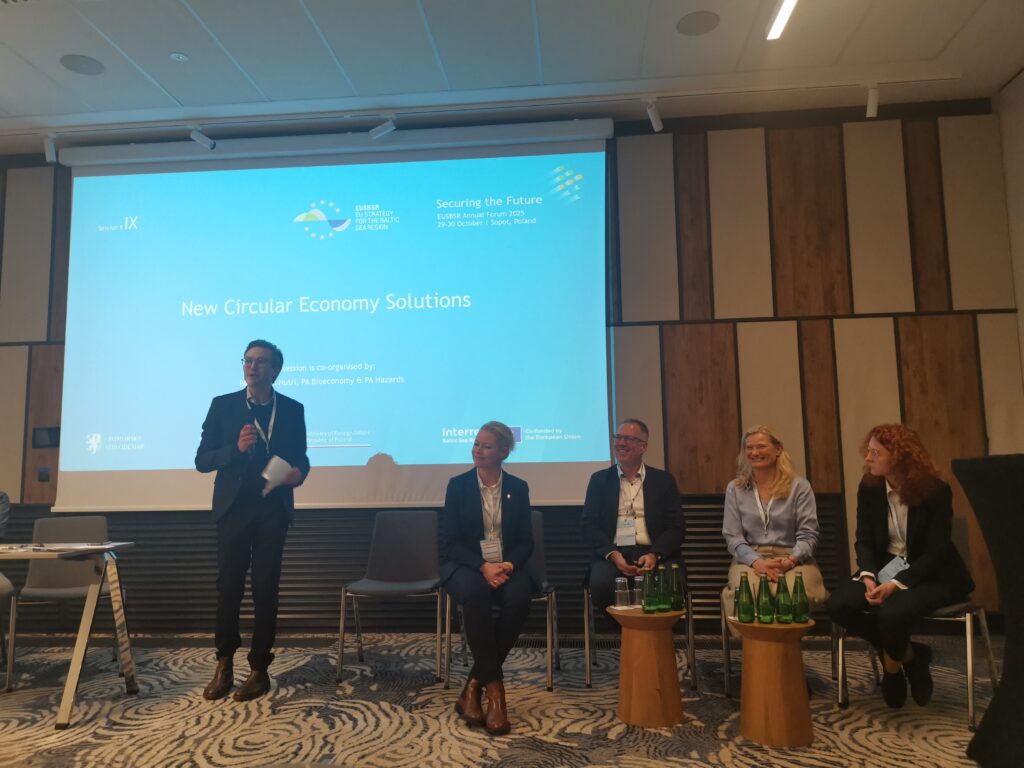
Circular economy is not only selling one’s old clothes and furniture, but it is about making sustainable decisions in all sectors. Four speakers from five different projects of several Policy Areas gathered together for a panel discussion in the EUSBSR Annual Forum in Sopot, Poland. All these projects are working in completely different fields, but one thing they all had in common was Circular Economy.
The discussion was moderated by Adam Høyer Lentz, Policy Area coordinator for PA Bioeconomy. First up was Paula Biveson, representing projects CiNURGi & FERTITEC. Project CiNURGi focuses on promoting circular economy of nutrients in the Baltic Sea Region and it aims to upgrade technology to recover nutrients from biomass and other agricultural and industrial streams. Whereas FERTITEC is a Horizon Europe project designed to turn waste and secondary raw materials into high-quality fertilisers and thereby advancing both sustainable agriculture and the circular economy. Next project in line called GYPREG, represented by Aleksandra Najda, focuses on the agri-environmental measure of using gypsum (calcium sulphate) as an amendment to reduce phosphorous losses from soil and thereby help protect the Baltic Sea environment. Fourth project Achieving Zero PFAS represented by Prof Dr. Edita Baltrėnaitė-Gedienė, where the aim is to tackle the environmental hazards of PFAS (per- and poly-fluoroalkyl substances) by facilitating cooperation, knowledge-sharing and capacity building. Last but not least, Gunnar Platz introduced the Circular Ports project, bringing their knowledge about circular economy in the port environment. He demonstrated how bureaucracy can hinder the implementation of circular economy, but there is a potential for a new business opportunity by utilizing the circular raw material gained from ports, since EU manufacturers spend 40% on materials, closed-loop models would boost profitability, reduce resource price risks, and improve resilience. Although these projects and their topics differ significantly, there was still a consensus between all the panellists that a holistic approach to Circular Economy is needed in all sectors, and it is one of the best ways to prevent over consumption of natural resources.
Why is Circular Economy important?
Circular economy has often been an overlooked topic in many sectors. However, our panel brought together experts from vastly different fields highlighting how circular practices can drive innovation and sustainability across different industries. The discussion emphasized that collaboration on many fields and diverse sectors is essential and can even be the key in closing resource loops, reducing waste, and building a more resilient economic system.
Panel Discussion
The moderator asked the panellists which values that circular economy will bring to the Baltic Sea Region and of policy changes that should be made in the world of circular economy. All the panellists agreed that there is added value to the region, that it can benefit businesses in the long run, and that current technologies are advanced enough already to support the adoption of circular economy in many sectors.
“The barriers are no longer technical; they’re policy, infrastructure, and market development,” noted Paula Biveson from projects FERTITEC and CiNURGi.
High initial costs of implementing circular systems, such as redesigning products, or establishing recycling infrastructure, can discourage actors from transitioning to circular economy. As well as regulatory and policy gaps, since many existing laws and incentives are still designed around the traditional linear “take-make-dispose” model. All the projects in the panel discussion are trying to find solutions to break this linear model and make it more circular, this would not only affect the use of raw materials, but it would also minimize the contaminant footprint. The link between contaminant footprint and circular economy sits at the intersection of sustainability, pollution prevention, and resource efficiency.
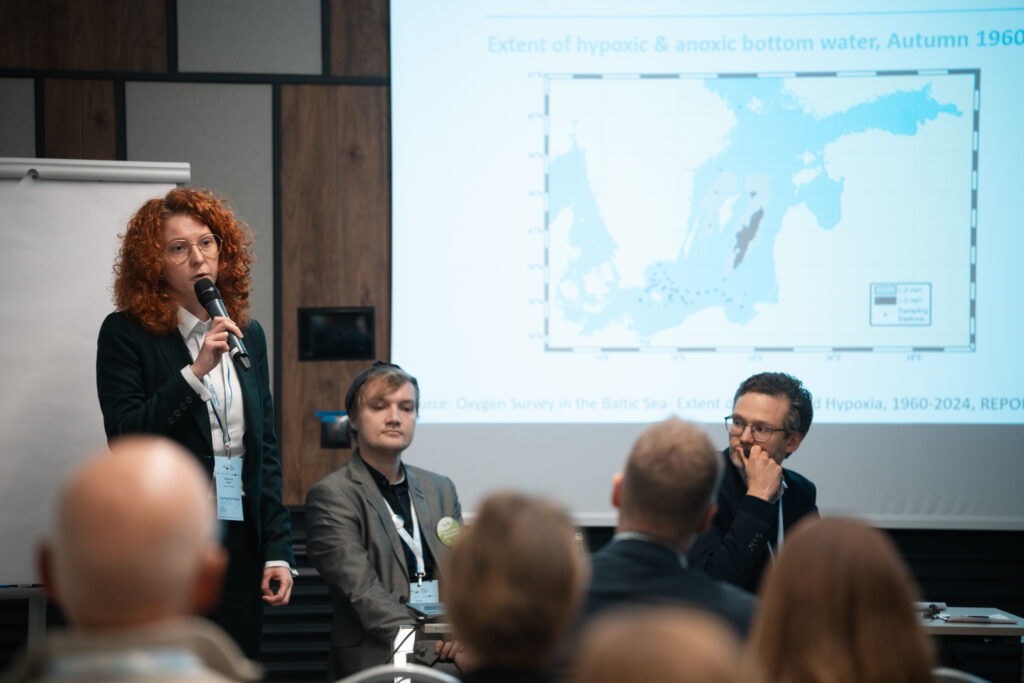
“Maintaining environmental resilience is crucial for the effectiveness of a circular economy,” said Prof Dr. Edita Baltrėnaitė-Gedienė.
In the Baltic Sea Region, the circular economy plays a vital role in addressing nutrient management, particularly in tackling eutrophication, one of the area’s most pressing environmental challenges. A circular approach seeks to close nutrient loops by recovering and reusing these elements instead of allowing them to pollute waterways. For example, nutrients from agricultural waste, manure, and wastewater can be recycled into fertilizers or biogas production, reducing both nutrient leakage and dependence on synthetic fertilizers. By improving nutrient recycling and promoting sustainable agricultural and waste management practices, the circular economy offers a pathway to mitigate eutrophication while supporting more resource-efficient and resilient systems in the Baltic Sea region.
“The circular economy for nutrients is poised for scaling. The question is: how fast can we move?” remarked Paula Biveson from projects FERTITEC and CiNURGi.
Connection to EUSBSR Policy Area work
The projects were invited to the panel discussion by the Policy Area Coordinators of the EUSBSR and they all implement the Actions set in the Action Plan and the overall goals of the whole Macro-Regional Strategy. Saving the Sea by mitigating the nutrient loads, persistent chemicals (e.g., PFAS) and the pollution ending up in the sea, also mitigating climate change by circulating waste as the raw materials in the region. Increasing Prosperity by creating new business opportunities and mitigating the harm done to the ecosystem and its services. And Connecting the Region by bringing together people transnationally in projects as well as implementing and sharing the project results across the Baltic Sea region and even further across the globe.
Conclusions
The panel in Sopot made on thing clear; circular economy isn’t just about recycling or reusing materials, but it’s about rethinking how we design, produce, and collaborate across every sector. From recovering nutrients and turning waste into fertilisers, to tackling harmful chemicals and transforming ports into circular hubs. Each project showed how innovation can thrive when sustainability is placed at the centre.
The discussion also highlighted that the biggest challenges ahead aren’t about technology, but they are about changing policies, markets, and mindsets. But with shared goals and cooperation across borders, the Baltic Sea Region is already showing how circular solutions can save resources, boost business opportunities, and protect our environment for the future generations.
By working together, these projects are not only saving seas, but they are also shaping a more resilient and connected region, one circular step at a time.
Securing the Future – Views from the Policy Area Coordinators
“Securing the Future – Views from the Policy Area Coordinators” publication consists of thematically focused articles that are aligned with the Strategy objectives and support informed discussion.
To read more about the XXX, read the article XXX.
Download the publication here.
More about the Annual Forum
- Securing the Future – Views from the Policy Area Coordinators
- Building the Baltic Sea Region’s AI Future: From Hype to Real Impact
- New Circular Economy Solutions: Perspectives to Circular Economy in a Panel Discussion
- Energy Transformation: pathways to Baltic Sea region‘s energy resilience
- The Soft Core of Hard Security: Community Cohesion and Agency in Times of Insecurity
- Routes That Resonate: Tourism and Culture as Bridges in the Baltic Sea Region
- Economy of Wellbeing of People: Building Sustainable Working Lives in the Baltic Sea Region
- Regions bordering Russian Federation and Belarus
- Beyond Borders: Turning Interreg Results into Policy Action
- Are Our Green Fuels Ready for Green Shipping Corridors?
Related content
New funding opportunities at Swedish Institute
26 February 2026