
Together, we are building a green, prosperous and well-connected Baltic Sea Region.
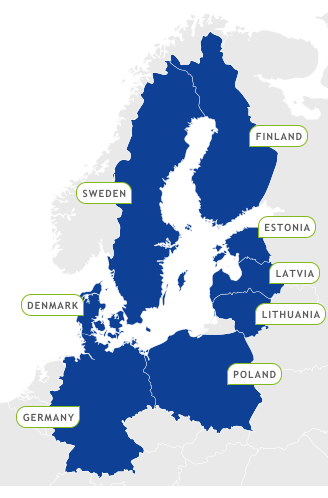
The EU Strategy for the Baltic Sea Region is an agreement between the European Commission and the EU member states bordering the Baltic Sea: Denmark, Estonia, Finland, Germany, Latvia, Lithuania, Poland and Sweden. It fosters cooperation and finds common solutions to joint challenges on a macro-regional level.
The Strategy has three objectives:
- Save the Sea
- Connect the Region
- Increase Prosperity
To achieve these objectives, the Strategy’s Action Plan identifies the most important actions for implementation. The actions are thematically divided into Policy Areas (PAs) which are all linked and contribute to achieving these objectives from different angles and in diverse ways.
The Strategy was the first macro-regional strategy and approved by the European Council in 2009 following a Communication from the European Commission. It was set up as a unique platform for cooperation and coordination with open and transparent participation, inclusiveness, and a multi-level governance approach. The Strategy contributes to a better division of labour and reduces overlaps among existing networks and organisations in the region.
Each year one member state takes over the Presidency in the Strategy for twelve months. Currently, Estonia is holding the Presidency.
FREQUENTLY ASKED QUESTIONS
What is a macro-regional strategy?
A macro-regional strategy is an integrated framework endorsed by the European Council, which may be supported by the European Structural and Investment Funds among others, to address common challenges faced by a defined geographical area relating to EU Member States and third countries located in the same geographical area which thereby benefit from strengthened cooperation contributing to achievement of economic, social and territorial cohesion.
Find more information here.
What are Policy Areas?
Policy Areas (PAs) represent the expertise in their respective areas of activity and ensure the implementation of the Strategy and the Action Plan. Policy Areas are managed operationally by one or more Policy Area Coordinators (PACs) coming from a Member States’ official authority of the national or regional government. The work of the Policy Area and of the Policy Area Coordinator is supported and guided strategically by their respective by a respective Steering Group (SG).
What countries are involved in the Strategy?
The EU member states involved in the Strategy are Sweden, Denmark, Estonia, Finland, Germany, Latvia, Lithuania and Poland. The Strategy’s implementation is coordinated in close contact with the European Commission and all relevant stakeholders, i.e. other member states, regional and local authorities, inter-governmental and non-governmental bodies.The Strategy is also welcoming cooperation with EU neighbouring countries (Iceland and Norway).
How is the Strategy financed?
The Strategy itself does not have its own funding by principle.
Instead, it embodies the concept of macro-regional cooperation which is based on a better and more coordinated use of existing funding sources, and the promotion of synergies and complementarities. The partners in the Region may for example make use of the funding they receive through EU cohesion funds, other EU programmes and financial instruments, and various international financial institutions.
“[The Strategy] is financially neutral and relies on a coordinated approach, synergistic effects and, on a more effective use of existing EU instruments and funds, as well as other existing resources and financial instruments.”Council Conclusions, 2009
The European Social Fund Plus, European Regional Development Fund, Cohesion Fund, European Agricultural Fund for Rural Development and European Maritime and Fisheries Fund are key funding sources of the Strategy. However, the actions and projects under the Strategy and its Action Plan can be funded by many other financial sources like Horizon Europe, the LIFE programme, Education and Culture programmes, or numerous cross-border and regional programmes such as the Interreg Baltic Sea Region Programme as well as national, regional, private sources.
Are you looking for funding or an opportunity to engage in the implementation of the Strategy?
Contact the Policy Area Coordinator of your field of expertise to find out how to best get involved!
How can I get involved?
The Strategy is based on open and transparent participation, inclusiveness and multi-level governance. The wide thematic coverage of the Policy Areas provides opportunities for different kinds of stakeholders to participate and propose various kinds of activities. While the Strategy promotes building-up longer-term networks and platforms, new stakeholders as well as novel ideas and initiatives are welcome!
Among the established stakeholders are national, regional and local authorities, intergovernmental and non-governmental bodies, universities and research organisations. However, there is a need to increase the involvement of NGOs, civil society, youth organisations and the business community.
To find out more, please contact the Policy Area Coordinator(s) of the Policy Area you want to work with!
Why do we need a Strategy for the Baltic Sea Region?
The Strategy is an agreement between the EU Member States bordering the Baltic Sea and the European Commission to strengthen cooperation. Only together, we can meet the common challenges facing the region – be it climate change, environmental issues or the green transition of the industry. The Strategy for the Baltic Sea Region wants to create joint opportunities, everybody can benefit from and build a green, prosperous and well-connected region.