
 Back
BackWhy is the EU Strategy for the Baltic Sea Region important?
More than 100 representatives of Danish civil society organisations took part, onsite and online, in a seminar at Europe House in Copenhagen on 2 September 2026 to discuss why the EU Strategy for the Baltic Sea Region (EUSBSR) matters and how civil society can contribute to its implementation.
The seminar was organised by the Danish Baltic Sea NGO Network, the Danish UN Association, the European Movement, the Norden Association Sweden, the European Commission Representation in Denmark and the Helsinki Committee for Human Rights.
Jens William Grav of the Danish Baltic Sea NGO Network welcomed participants and introduced the theme. The Baltic Sea Region faces major challenges that cross national borders, but it is also a region with strong traditions of transnational cooperation between democratic countries, municipalities, businesses, academic institutions and civil society.
Common challenges call for common solutions, developed across borders and sectors. The EUSBSR provides a shared framework for such cooperation, to which Danish civil society organisations are welcome to contribute. By building networks and platforms for new ideas and activities, civil society can strengthen active citizenship, democratic participation and cohesion across the region. The current geopolitical situation makes stronger regional cooperation and a shared awareness across the Baltic Sea more important than ever.
Stefan Welin, Deputy Head of the European Commission Representation in Denmark, introduced the background and purpose of the EUSBSR from an EU perspective.
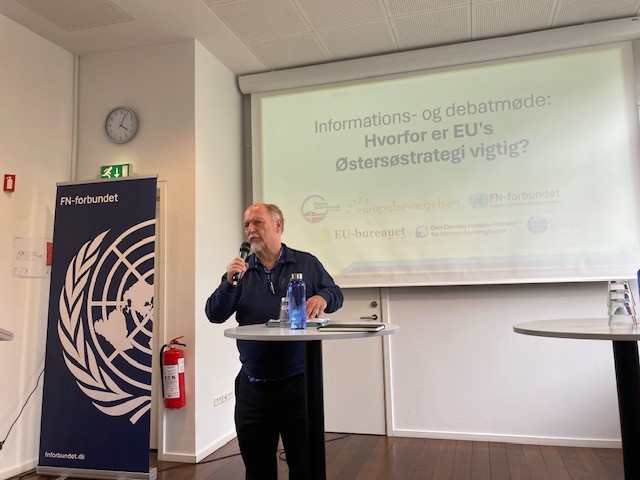
EU enlargement, which brought four more Baltic Sea Region countries into the Union, combined with the urgent need to address the effects of climate change on the water quality of the Baltic Sea, contributed to the creation of the EU’s first macro-regional strategy.
Three more macro-regional strategies have since followed in Europe, with a fifth now emerging. Macro-regional strategies provide strategic frameworks for transnational cooperation. They are built on cross-sectoral, multilevel and transnational collaboration in which stakeholders jointly address common societal challenges. In this way, they can deepen European integration and widen participation.
Bjarke Brix Olsen, National Coordinator for the EUSBSR at the Danish Ministry of Foreign Affairs, presented the priorities of the Danish Presidency in 2026–2027.
Denmark is an active contributor to Baltic Sea cooperation, not least in the fields of defence and civil protection. With the new EUSBSR Action Plan being adopted this year, a central priority of the Presidency is to move “from words to action” and support the Policy Area Coordinators in implementing the new actions. Involving Norway, the newest member of the Strategy, in its implementation is another priority. Denmark’s specific thematic interests include maritime safety, clean shipping and civil protection.
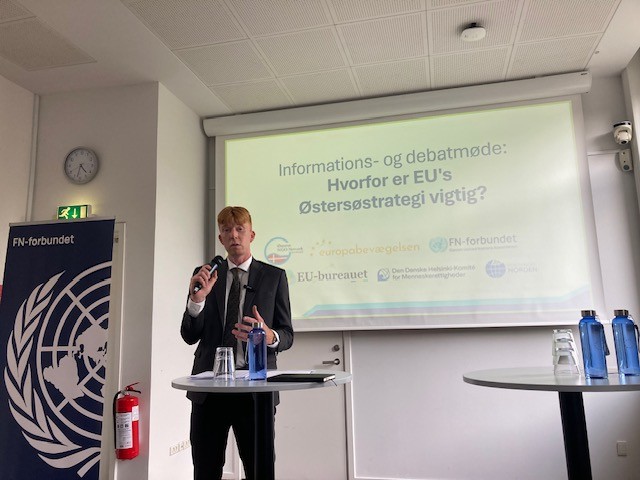
Anders Bergström, Policy Area Coordinator for EUSBSR Policy Area Education at the Norden Association Sweden, explained how the Strategy is implemented and how civil society organisations can take part.
Successful implementation of macro-regional strategies depends on sustainable transnational platforms where stakeholders can come together to develop solutions to shared challenges. Organisations participating in such platforms are often financed through projects, including Interreg and other programmes. The aim is also to align a broader range of financing through mainstream programmes, including the European Social Fund and the European Regional Development Fund.
Civil society organisations contribute valuable expertise to these platforms. Save the Children and the Red Cross, for example, take part in cooperation related to the integration of migrants, while environmental organisations contribute to platforms working to protect the Baltic Sea. Civil protection is another area where civil society organisations are active.
More civil society organisations are welcome to become involved in the Strategy, and the Policy Area Coordinators can provide a first point of contact.
The Q&A session that followed was moderated by Rasmus Nørlem Sørensen, Secretary General of the Danish UN Association. The discussion covered a broad range of topics, including youth involvement, strategic autonomy, labour market integration and support for Ukraine. Participants also shared examples of how the Strategy can make a difference on the ground and how civil society organisations can contribute.
In relation to support for Ukraine, participants highlighted the training of first responders. A folk high school in Ukraine is offering train-the-trainer courses in first aid, trauma care and de-mining with trainers from the Baltic Sea Region.
Another practical outcome of cooperation within the Strategy is the development of Youth Guidance Centres, where multidisciplinary teams support young people who are not in employment, education or training (NEET) towards vocational training and, in time, the labour market. A model for such centres has been developed on the basis of good examples from across the Baltic Sea Region and is now being established in Lithuania and Poland.
Closing the seminar, Ole Meldgaard of the Danish Baltic Sea NGO Network thanked the speakers and participants for an informative afternoon and for the discussions on the importance of Baltic Sea Region cooperation, not least at a time of geopolitical uncertainty.