
Forum Programme
The EUSBSR Annual Forum 2025 consists of plenary sessions and parallel thematic sessions in varying engaging formats. In addition to the stage programme, participants are invited to enjoy networking opportunities and explore the beautiful city of Sopot.
On the day before the Annual Forum, 28 October, BSSSC organises a Day of Cities and Regions to bring together regional and local actors from across the Baltic Sea Region. Please note that both event require a separate registration.
Official Forum Programme
Forum’s schedule
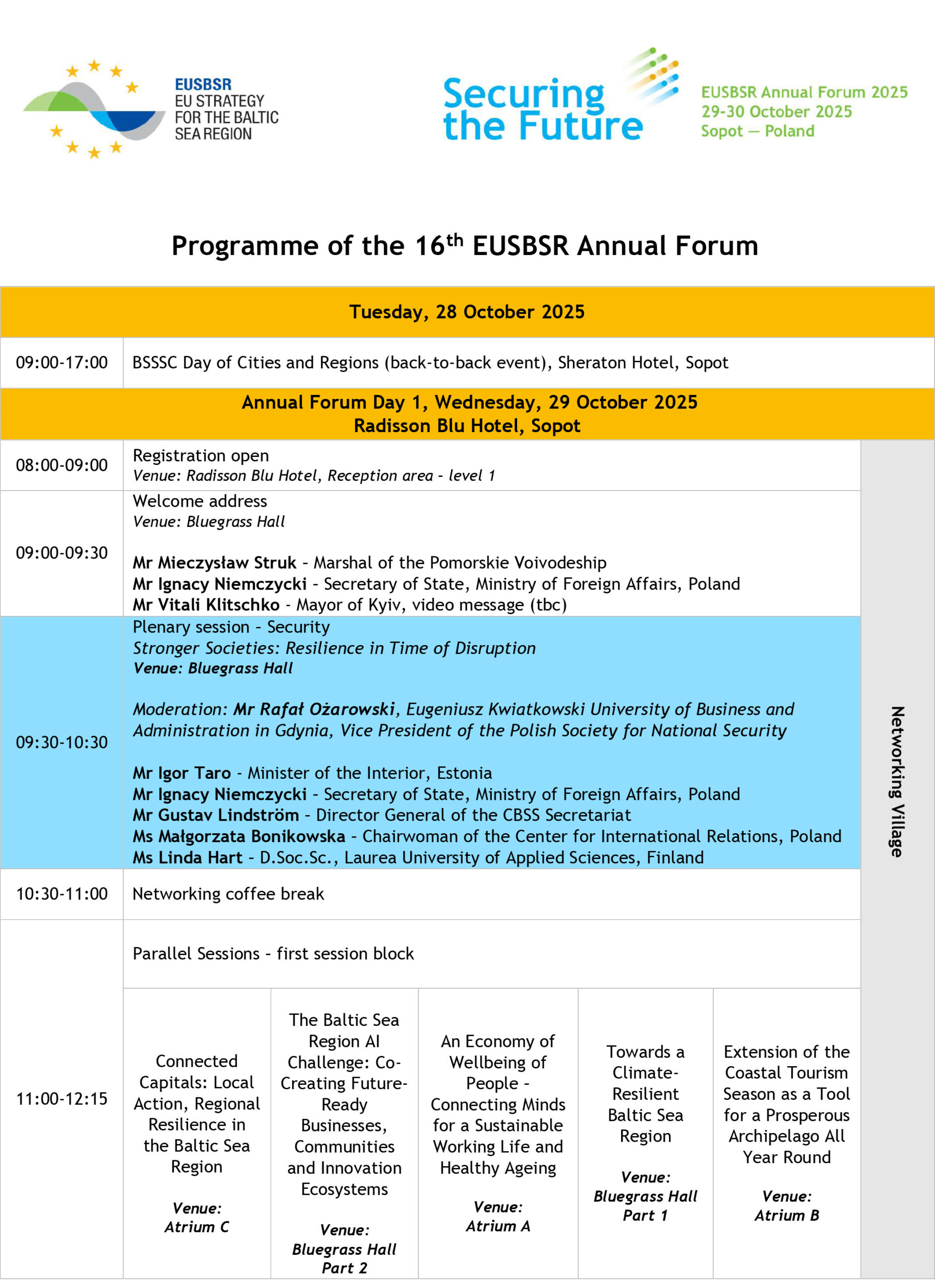
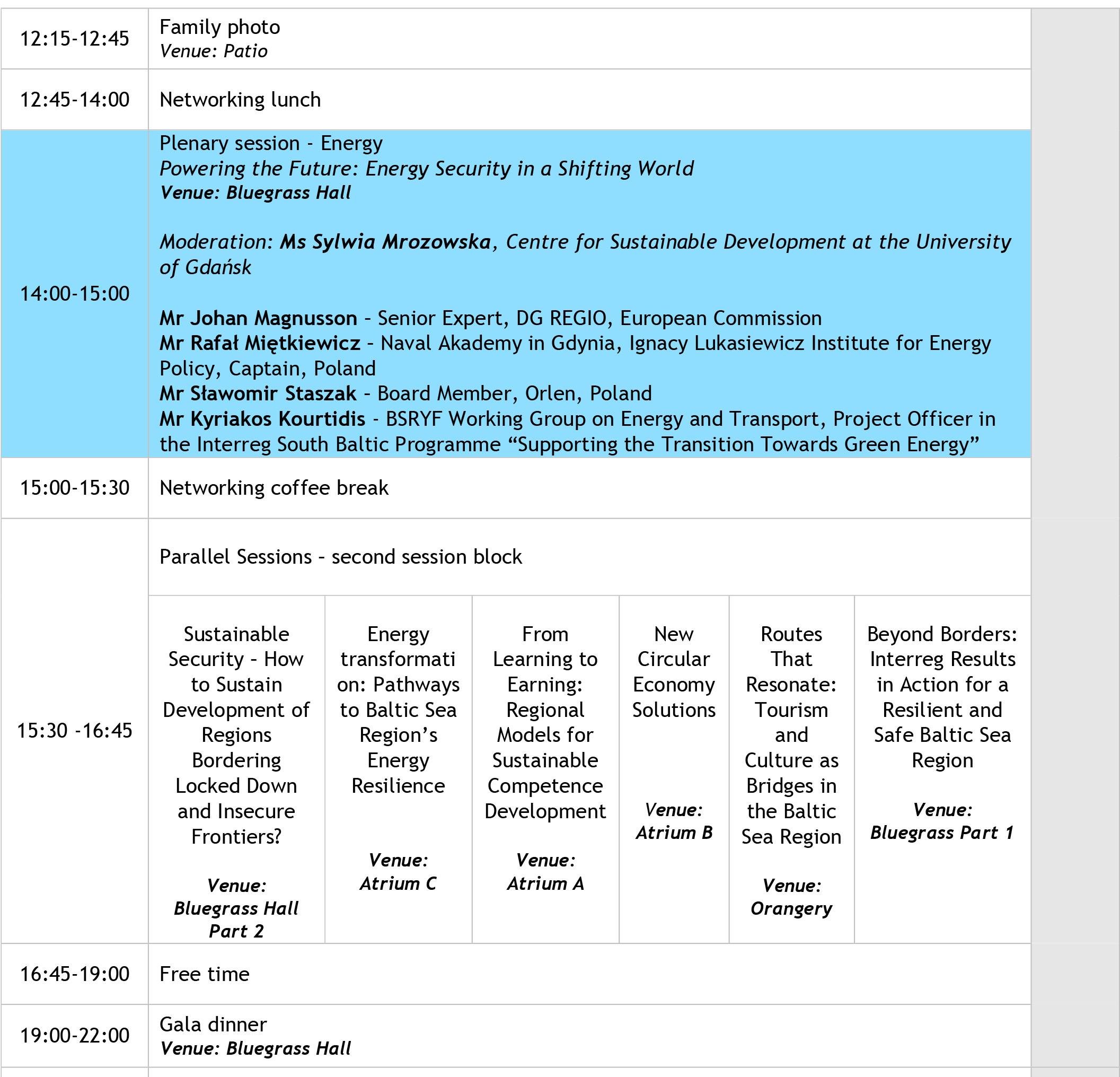
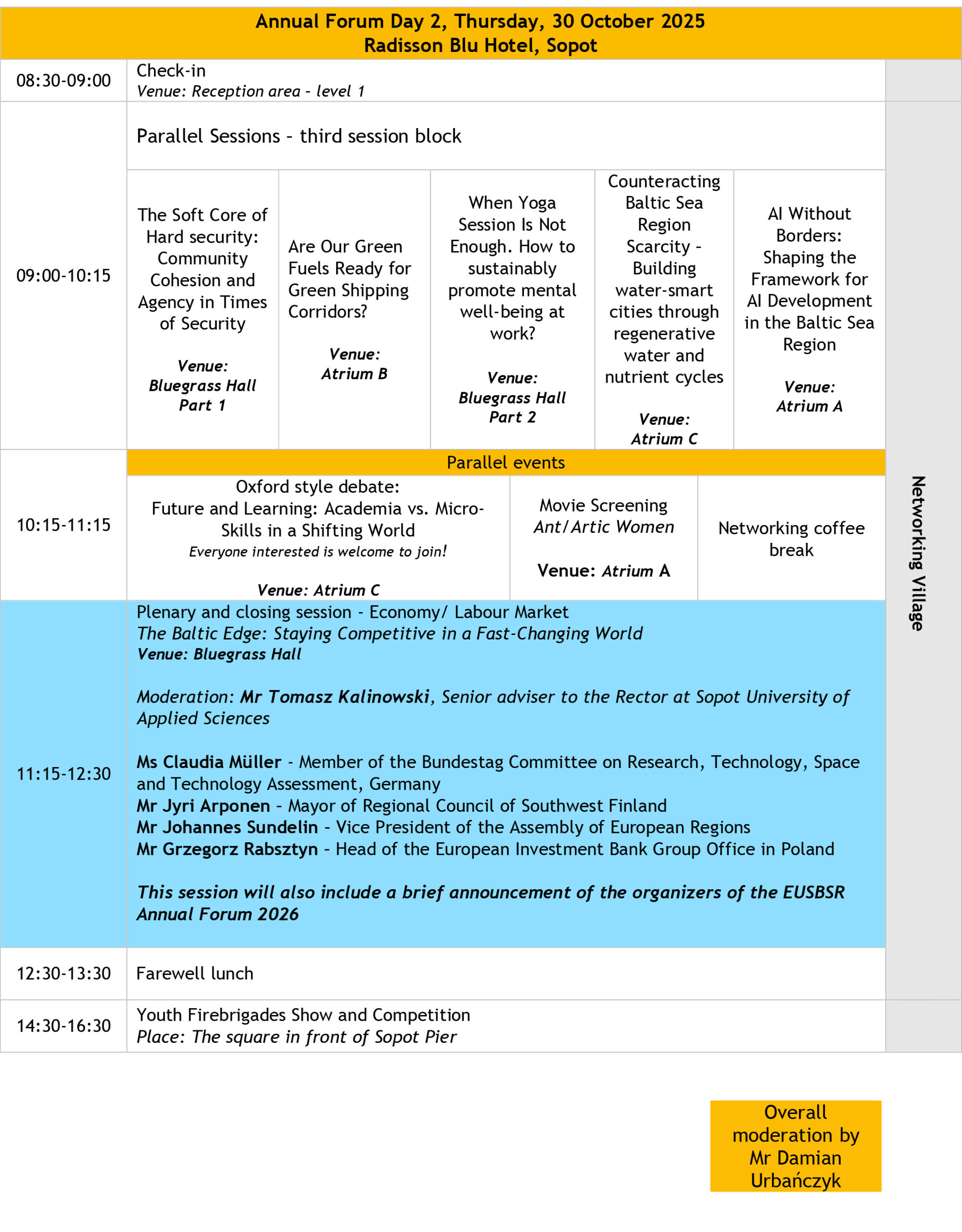
Please note that this is a preliminary programme and may be subject to changes.
We kindly ask you to regularly check the EUSBSR website for the latest updates.
If you have any questions, please feel free to contact us at: zagranica@pomorskie.eu
You can also reach out directly to:
Ms Ewa Jagodzińska,
e.jagodzinska@pomorskie.eu, +48 502 757 345
or
Ms Agata Birecka
a.birecka@pomorskie.eu +48 571 223 242
Download the programme here.
Parallel Sessions – Day 1, morning
Session I
Connected Capitals: local action, regional resilience in the Baltic Sea Region (SESSION FULL)
This interactive workshop brings together capitals of the Baltic Sea Region to exchange experiences and needs in building urban resilience. Participants will explore solutions for protecting critical functions and engaging civil society, while contributing ideas for future joint projects. Lessons from both the COVID-19 pandemic and wartime Kyiv will guide the discussion.
The session is organised by Policy Area Secure coordinators CBSS Secretariat & MSB (Civil Contingencies Agency, Sweden), together with Union of Baltic Cities (Safe cities commission).
Session II
The Baltic Sea Region AI Challenge: Co-Creating Future-Ready Businesses, Communities and Innovation Ecosystems (SESSION FULL)
How to unlock the transformative power of AI for the Baltic Sea region? This workshop brings policymakers and digital economy stakeholders together to explore how macro-regional collaboration, smart governance and skills development can accelerate smart growth and innovate business environment, drive green and socially relevant and sustainable innovation, leverage the macroregional visibility, connectivity and innovation excellence and boost resilience and build a trustworthy, inclusive AI ecosystems across the Baltic Sea Region.
The session is organised by Policy Area Innovation Coordinators: The Baltic Institute of Finland and Ministry of Economic Development and Technology of Poland.
Session III
An Economy of Wellbeing of People – Connecting Minds for a Sustainable Working Life and Healthy Ageing (SESSION FULL)
In this workshop, we will highlight some of the societal challenges connected to working life and health. The policy dialogues at the workshop will feed into ongoing a Baltic Sea Region wide process to address complex demographic challenges and challenges related to competence supply for a successful green transition. We invite you to join us for both vibrant discussions and co-creation of solutions.
The session is organised by Policy Area Education Coordinator Norden Association Sweden.
Session IV
Towards a Climate-Resilient Baltic Sea Region
This session showcases collaborative climate change adaptation efforts in the Baltic Sea Region, highlighting tools and strategies for a climate-resilient macro-region. Featuring insights from the Baltic PlaNet project platform as well as Interreg Baltic Sea Region projects ClimaResponse, and CommitClimate, the session will explore solutions for coastal planning, disaster risk reduction, and energy transition. The session promotes integrated, cross-sectoral approaches to build a climate-proof Baltic Sea Region.
The session is organised by Policy Area Spatial Planning Coordinator organisation VASAB, and co-organised by Policy Areas Secure and Energy.
Session V
Extension of the Coastal Tourism Season as a Tool for a Prosperous Archipelago All Year Round (SESSION FULL)
The workshop will explore innovative approaches to extend the coastal tourism season and raise resilience and attractiveness of archipelagos and make it a sustainable year-round destination. It will address the issue of transport accessibility by lifting transport public services, ports, responsible boating, and regional uniqueness as key assets. It will feature cases from ongoing projects like Interreg Baltic Sea Region project “Light in the Dark” and Interreg South Baltic project “Boatman” initiatives as well as the promotion of the year-round vitality of the archipelago in Stockholm region.
The session is organised by Policy Area Tourism Coordinators and The CPMR Baltic Sea Commission.
Parallel Sessions – Day 1, afternoon
Session VI
Sustainable security – how to sustain development of regions bordering locked down and insecure frontiers? (SESSION FULL)
During this session, politicians as well as representatives of regions discuss the areas bordering Russian Federation and Belarus. Dynamic, two-part session (“political” and “socio-economic”) abounds in common challenges that the border regions are facing – depopulation, economic isolation, sense of insecurity – just to name few. The current situation also creates opportunities for those regions – for example building strong ties and durable networks of cooperation and information flow.
Three years have passed since outburst of Russian’s aggression against Ukraine. Security issue is still high on European Union’s agenda and it requires further attention. Entire Baltic Sea community has the right to live in a developing and safe region.
Study visit on 30th of October at 08-15:00 (Please note that the time has changed! Previously: 09-14:00)
You are also invited to join a study visit, held in Malbork. The visit is an extension to the discussion during the session: concrete examples of problems faced by entrepreneurs and local authorities from Pomorskie Voivodeship and Warmińsko-Mazurskie Voivodeship.
The session and the study visit are organised by The Office of the Marshal of the Pomorskie Voivodeship.
Session VII
Energy transformation: pathways to Baltic Sea region’s energy resilience
This session will explore the critical pathways toward enhancing energy resilience in the Baltic region. Experts will highlight the opportunities and challenges presented by offshore wind development, hydrogen, and emerging technologies like smart grids, alongside the ongoing need for cross-border cooperation and infrastructure modernization. With a focus on resilience, the session will delve into how the Baltic region is advancing towards a sustainable, low-carbon future, while reinforcing its energy security in a rapidly changing geopolitical climate.
The session is organised by Policy Area Energy coordinators: Ministry of Climate and Energy of Latvia, Lithuanian Energy Agency, Ministry of Climate of Estonia.
Session VIII
From Learning to Earning: Regional Models for Sustainable Competence Development (SESSION FULL)
This session aims to explore how regional models for skills development can meet future needs. The topic is viewed from the angle of integrating STEAM, strengthening collaboration between education and the labor market and supporting the implementation of the EU Strategy for the Baltic Sea Region objectives. Integrated STEAM education in European schools is an approach to preparing a quality STEM (science, technology, engineering and mathematics) workforce and literate citizens for a highly technology-based society.
In the forest-rich region of Småland, a culture of practical creativity and problem-solving has long shaped both industry and education. In Kronoberg County, this spirit lives on through Mot nya höjder – a regional STEAM initiative driven by Region Kronoberg as a long-term skills development concept, in and for schools. Launched in 2015, Mot nya höjder integrates Science, Technology, Engineering, Arts, and Mathematics into everyday learning. The inclusion of the arts – design, creativity, and interdisciplinary thinking – is a deliberate choice, rooted in the belief that innovation requires more than technical knowledge.
The session is organised by Region Kronoberg.
Session IX
New Circular Economy Solutions
Circular Economy is not just about selling your old clothes or furniture. It’s about making sustainable decisions on all the sectors. In this panel discussion projects from Policy Areas Ship, Nutri, Bioeconomy and Hazards come together to talk about Circular Economy in various sectors and promoting sustainable solutions, business opportunities and what needs to be done next.
The session is organised by Policy Area Ship, Nutri, Bioeconomy and Hazards Coordinators.
Session X
Routes That Resonate: Tourism and Culture as Bridges in the Baltic Sea Region (SESSION FULL)
Can saunas, medieval trade and shared memories drive tourism and strengthen regions? Yes – through culture in motion. This session explores how cultural routes turn local heritage into meaningful travel experiences, linking people and places across orders. From history to wellbeing, we’ll show how tourism grounded in culture not only builds identity but also fosters cooperation, visibility and resilience in the Baltic Sea Region.
The session is organised by Policy Area Tourism and Culture Coordinators.
Session XI
Beyond Borders: Interreg Results in Action for a Resilient and Safe Baltic Sea Region (SESSION FULL)
This session showcases how Interreg Baltic Sea Region projects deliver concrete solutions for a resilient and safe region. From community resilience and clean energy to flood prevention and circularity, we explore which results are mature enough for policy uptake, what gaps remain, and how to take the next steps in transferring high-impact outcomes to the Strategy, so Interreg ingenuity becomes Baltic-wide practice.
The session is organised by Interreg Baltic Sea Region Managing Authority/Joint Secretariat.
Parallel Sessions – Day 2, morning
Session XII
The soft core of hard security: Community cohesion and agency in times of insecurity
As uncertainties rise, security dominates public debate — often focusing on hard measures like infrastructure or military. But resilience starts with people and communities. This session explores how civil preparedness and mental resilience can strengthen the fabric of society. By showcasing innovative and culture-based approaches, we’ll examine how the arts and creative expression can foster solidarity (“togetherness”), nurture mental resilience and reinforce social cohesion and democratic values in the face of crisis.
The session is organised by Policy Area Culture and Secure Coordinators.
Session XIII
Are our green fuels ready for green shipping corridors? (SESSION FULL)
While more and more ports are attracted by the idea of being connected via green shipping corridors, there is uncertainty what is going to fuel these corridors and whether we are ready for emergencies involving green fuels. Vessels are being designed and built to use green fuels. Simultaneously, we are lacking knowledge and skills to serve these vessels. For these reasons, there is a need for an overview of green fuel producers and suppliers as well as capability of handling green fuels.
The session is organised by Policy Area Transport, Ship and Safe Coordinators.
Session XIV
When Yoga Session Is Not Enough. How to sustainably promote mental well-being at work? (SESSION FULL)
“We’re like a family here” might sound inviting, but in small workplaces, it can blur boundaries and hide burnout risks. How can micro and small enterprises (SMEs) tackle psychosocial risks and create healthier, more sustainable work environments?
The session is organised my Policy Area Health Coordinator organisations: Northern Dimension Partnership in Public Health and Social Well-being, National Institutions responsible for health and safety at work.
Session XV
Counteracting Baltic Sea Region Scarcity – Building water-smart cities through regenerative water and nutrient cycles
The panel touches on the topic of increased water stress caused by climate change, which has an impact on various spheres including tourism, urban management, policies and strategies.
The session is intended to promote cooperation through the joint dialogue on innovative solutions such as nature-based closed-loop models, ‘waste-to-resource practices’, ‘local nutrient loops’ for sustainable water management, and the search for common answers to existing problems in the Baltic Sea regions.
The session is organised by Policy Area Nutri Coordinators together with Euroregion Baltic Water Core Group, Association of Polish Communes Euroregion Baltic and four project initiatives funded by Interreg Baltic Sea Region: WaterMan, Nursecoast II, ReNutriWater, CityBlues.
Session XVI
AI without borders: Shaping the Framework for AI Development in the Baltic Sea Region (SESSION FULL)
What political, ethical, and digital conditions are needed to foster responsible AI development in the Baltic Sea Region?
Building on insights and showcasing results from recent [#b_hack] hackathons and Baltic Sea youth events, this interactive workshop will explore how to improve the structural environment for AI across borders and how to utilise AI in cross-border collaboration. Participants will discuss key challenges and opportunities related to regulation, digital skills, infrastructure, and cross-sector cooperation.
The session is organised by The Baltic Sea Region Youth Forum, CBSS.
Networking and more
Networking Village at the Forum, 29-30 October
The Networking Village remains a vibrant and essential hub during each Annual Forum of the EU Strategy for the Baltic Sea Region (EUSBSR). It offers a dynamic space for stakeholders—both new and experienced—to meet, exchange ideas, and explore opportunities for collaboration within the EUSBSR framework.
As in previous editions, the Networking Village will be situated at the heart of the Forum, close to the plenary room, serving as a key location for informal interactions, policy discussions, and knowledge sharing. It is designed to foster personal connections and provide access to valuable information about ongoing and planned activities under the EUSBSR.
Grab a coffee, settle into a cozy sofa and immerse yourself in new Baltic ideas—the Networking Village is where the first conversations begin, often turning into long-lasting partnerships. It’s a place where spontaneous chats over a cup of coffee can lead to concrete cooperation and new project ideas.
Participants will have the chance to engage directly with Policy Area Coordinators and representatives of various flagship projects, which represent practical cooperation across the Baltic Sea Region. These flagships bring together partners from different countries and governance levels—local, regional, and national—as well as from the public, private, and civil society sectors, all working together to address shared challenges and develop innovative solutions.
This year, the Networking Village is coming back with a fresh twist—a renewed look and feel, but the same spirit of connection and collaboration. No reservations, no formalities—just come as you are. Whether you’re planning to stop by for a quick chat or settle in for deeper conversations, the space is open to all.
To keep the focus on people and ideas, there will be no individual booths this year. Instead, a shared space will showcase leaflets, brochures, and other small materials from international organisations, funding programmes, and projects. It’s an easy way to highlight your work and a perfect opportunity for participants to discover inspiring initiatives from across the Baltic Sea Region.
Join us and let the Baltic inspiration flow!
Science Speed Dating, 28 October
The Fahrenheit Universities invite you to a networking event in the form of Science Speed Dating, which will take place on 28 October 2025. The format is based on a series of three-minute conversations between participants, aimed at establishing new connections and exchanging experiences.
We especially encourage participants interested in collaboration in the following areas: environment, society, economy and labor market, health, medicine, and food — all with a focus on the Baltic Sea Region.
Please note: the number of places is limited. Participants will receive a personal confirmation of their attendance in a separate message.
This exciting event is organized as a back-to-back event with the EUSBSR Annual Forum 2025 scheduled for 29 – 30 October 2025 — a perfect opportunity to dive deep into regional development and connect with like-minded professionals.
To register, please click here
Oxford-style debate, 30 October
Future and Learning: Academia vs. Micro-Skills in a Shifting World, Oxford-style debate on 30 October
Debate Hypothesis: Full-time academic studies are no longer the most effective path to building the skills needed for success and societal contribution in a rapidly changing world.
As the Baltic Sea Region navigates an era defined by fast-paced technological change, geopolitical uncertainty, and growing demands for sustainable development, the way we prepare people for the future is under scrutiny. Are traditional university degrees still the best investment in human potential—or are flexible, targeted learning experiences outside academia becoming the new gold standard? What should change in academic education for it to better respond to the needs of the world today?
This live debate brings together a unique mix of voices: young scholars, seasoned professors, business innovators, and local government leaders. Each team will argue for a different vision of how individuals and societies can best cultivate the knowledge and capabilities needed to thrive—whether through structured, long-term academic programs or through short, focused skill-building paths shaped by real-world challenges.
The session is part of the broader programme of the Annual Forum dedicated to regional cooperation and long-term stability. It will spark critical reflection on how education systems, employers, and communities can adapt to meet the demands of tomorrow—while staying rooted in shared values and a commitment to collective progress.
Get ready for a spirited exchange of ideas—and bring your own perspective to the conversation.
Tastes of Pomorskie
We warmly invite all participants of the EUSBSR Annual Forum 2025 to explore the Tastes of Pomorskie showcase in the Atrium foyer of the Radisson Blu Hotel. Regional exhibitors will present a curated selection of traditional and contemporary products that reflect the rich culinary heritage of Pomorskie.
Stop by, explore, and enjoy the true essence of our region. Let your senses guide you through the diversity and richness of Pomorskie identity.
Visitors will have the opportunity to sample selected products free of charge, and many items will also be available for purchase — perfect for taking home a piece of Pomorskie.
Meet the Producers
Chwastowe Pole
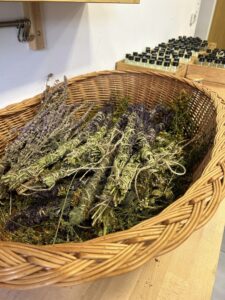
Chwastowe Pole is a producer of natural fruit and herbal vinegars, botanical cosmetics, and hand-picked herbs and teas. All products are made in harmony with nature and tradition, respecting the cycle of nature. It is a brand that focuses on locality and the authentic taste of plant ingredients. In addition, it runs wild cuisine workshops, during which it teaches cooking over a fire in the spirit of slow living.
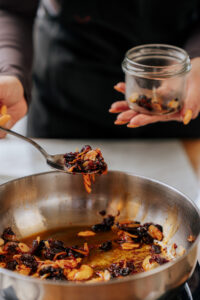 Kaszubskie Smaki
Kaszubskie Smaki cooks with passion and love for Kashubia, sharing what is most precious in the region – authentic flavours and culinary traditions. In their workshop, dishes are made from local ingredients, according to original recipes, combining Kashubian tradition with modern culinary techniques. Here you can discover the richness of regional flavours – from popular dishes to forgotten specialities brought back to life. Every bite brings you to the land of lakes, forests and extraordinary stories of Kashubia.
Sopot Tourist Card
Sopot Tourist Card
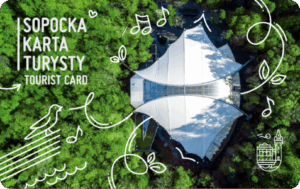
All participants of the EUSBSR Annual Forum are warmly invited to collect their Sopot Tourist Card during the event. The card is available at the Sopot Tourist Organisation information desk, located on the ground floor of the Radisson Blu Hotel—just to the left of the main entrance.
Thanks to the support of the Sopot Tourist Organisation, every forum participant will receive a card—whether you’re staying in Sopot, Gdańsk, or Gdynia. You can choose between a mobile version or a physical card, which also serves as a unique souvenir from Sopot!
In addition, exclusive Sopot-themed souvenirs will be available for purchase directly at the information desk—perfect as thoughtful gifts to bring home.
The Sopot Tourist Card grants you access to an exclusive selection of over 20 specially arranged offers across the city, prepared in collaboration with trusted local partners. These include:
- Special menus at selected restaurants and
- Discounts on spa & wellness treatments
- Reduced prices on Sopot souvenirs at Tourist Information points
Don’t miss out—stop by, pick up your card, and make the most of your time in Sopot!
Youth Fire Brigades Event
On 30 October 2025, as part of the Annual Forum of the EU Strategy for the Baltic Sea Region (EUSBSR), at 2:30 p.m. on Kuracyjny Square in front of the Sopot Pier, a presentation of Youth Fire Brigades will take place.
The event will highlight the very first steps of building trust and resilience within communities — through sport-based activities that help participants get to know one another, develop cooperation, and experience its international dimension.
The event will open with a firefighting drill demonstration performed from a fire and rescue vehicle by members of the Youth Fire Brigade at the Sopot Volunteer Fire Service.
Immediately afterwards, a second demonstration will follow — a rescue and first-aid operation involving the evacuation of an injured person from a smoke-filled pneumatic tent, carried out by members of the Youth Fire Brigade at the Gdynia Volunteer Fire Service of the Gdynia Urban Transport Company.
After the demonstrations, visitors and invited guests will be welcome to take part in three interactive stations:
- a rope-tying station, where participants can learn and practice basic knots used in rescue operations,
- a firefighting station featuring a water pump and a hand nozzle,
- a smoke-filled tent, where hidden objects can be located.
These hands-on activities will provide insight into the training and teamwork that shape young firefighting enthusiasts — fostering cooperation, responsibility, and engagement within their local communities. Most importantly, they will help participants discover their own resilience, experience a sense of agency and empowerment, and learn how to contribute to strengthening community preparedness and safety awareness — in a way that is both approachable and inspiring, thanks to the dedication of the Youth Fire Brigades and the Municipal Headquarters of the State Fire Service in Sopot.
BSSSC Day of Cities and Regions – 28 October
Join the Key Gathering of Baltic Sea Local and Regional Actors!
BSSSC Day of Cities and Regions – Join the Key Gathering of Baltic Sea Local and Regional Actors!
We are excited to invite you to the BSSSC Day of Cities and Regions, a brand-new back-to-back event that will take place on October 28, 2025, in Sopot. Organized by the Baltic Sea States Subregional Co-operation (BSSSC), this initiative is part of the EUSBSR Annual Forum, and is designed to bring together regional and local actors from across the Baltic Sea Region.
This year’s Forum focuses on Security and Resilience Building in the Baltic Sea Region, and BSSSC will contribute actively by addressing key topics such as:
- Culture and youth cooperation,
- Transport and maritime policy,
- Energy transition and energy security,
- Innovation transfer and artificial intelligence (AI),
- Cohesion policy beyond 2027.
What to Expect?
Workshops, interactive discussions, and networking sessions – a unique opportunity to connect with local and regional actors, civil society representatives, and youth organizations.
- Dialogue with EUSBSR Policy Area Coordinators – engage with the Strategy’s thematic leaders and contribute to future regional policy directions.
- Regional Leaders & Mayors Summit – the political highlight of the day. Top representatives of local and regional governments will present their priorities and adopt the BSSSC Resolution, which will be handed over to the Estonian Presidency of the EUSBSR.
- Interreg Baltic Sea Region Programme Future Lab – learn from ongoing and concluding projects, and contribute ideas for the future Interreg Programme beyond 2027.
Evening Highlight: Cultural Celebration
The event will close with a special cultural evening, co-organized by the Baltic Sea Cultural Pearls network.
Cultural programme and talks will be followed by a networking reception.
Be part of shaping the future of the Baltic Sea Region!
Download the programme here
Read more and register here